
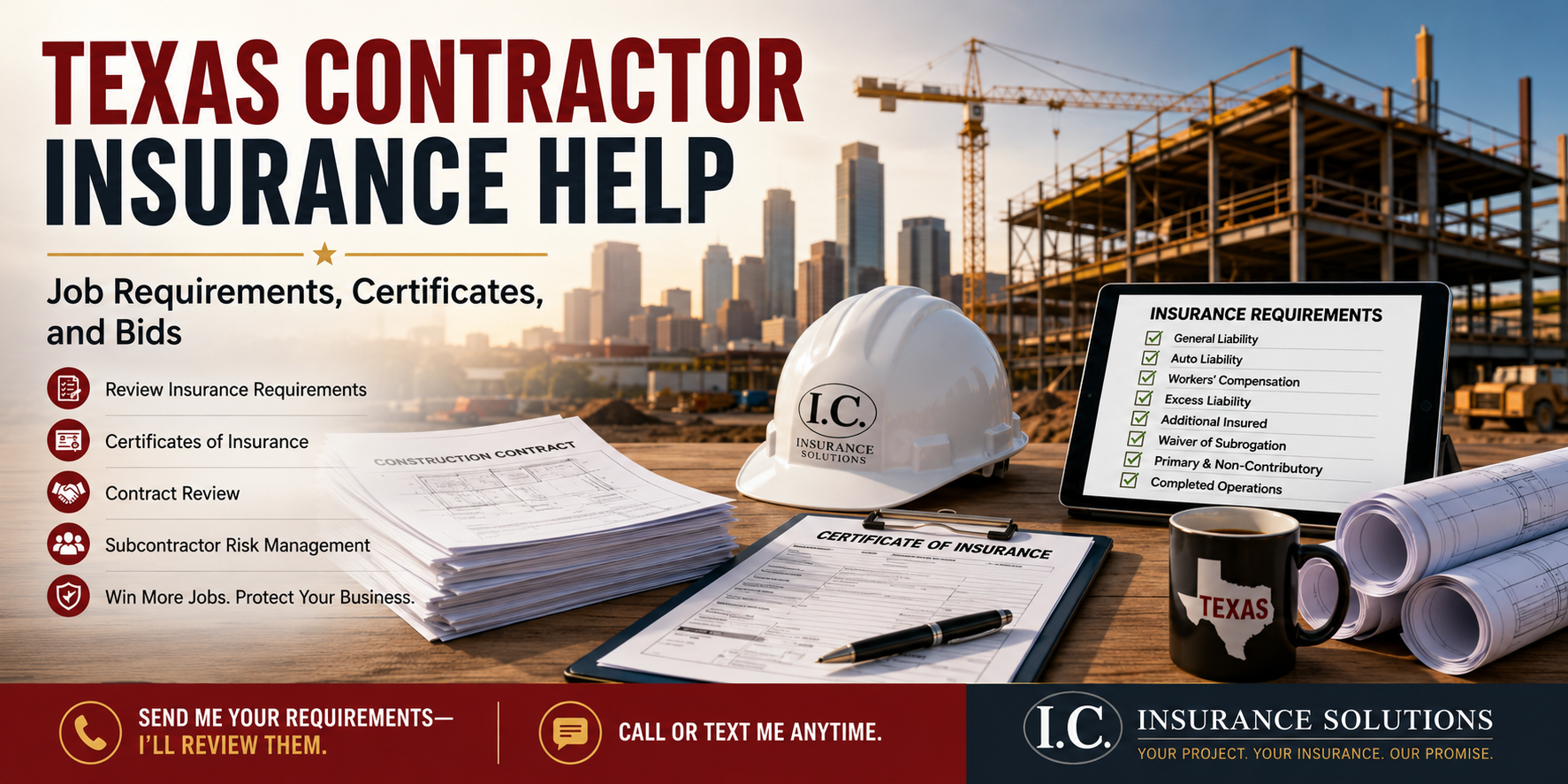
Texas contractors are usually not looking for insurance in the abstract. You are trying to start a job, qualify for a bid, send a certificate, understand a contract, or protect your business before work begins.
Whether you are a general contractor in Dallas, a specialty trade in Houston, or a builder near Austin, the right contractor insurance starts with one simple question:
What is the job asking you to provide?
At I.C. Insurance Solutions, we do not start with a generic policy conversation. We start with your project. Send over the certificate request, contract insurance section, or job requirements, and we will help you review what the owner, general contractor, or project manager is asking for.
That matters because the wrong insurance setup can delay a job, affect your bid, create certificate problems, or leave you carrying risk that should have been addressed before work started.
Before You Bid or Start the Job
Send your Texas job requirements, certificate request, or contract insurance section. We will review it with you and help you understand what may need to be handled before work begins.
Send me your requirements—I’ll review them.
Call or text me anytime.
Request A Quote
Prefer to talk? 1-800-922-9721
Key Takeaways for Texas Contractors
- Texas contractors often need insurance because a job, contract, or certificate request requires it.
- Insurance requirements should be reviewed before bidding whenever possible.
- A certificate alone does not mean every job requirement has been properly reviewed.
- Additional insured, waiver of subrogation, primary and non-contributory, and excess liability requirements can affect timing and cost.
- Texas general contractors using subcontractors need verification, documentation, and risk transfer.
- I.C. Insurance Solutions helps contractors review requirements, understand gaps, and prepare before work begins.
Need Contractor Insurance for a Texas Job? Start With the Requirements
The first step is often not asking, “What policy do I need?” The better first step is looking at the job itself.
Before we recommend anything, we want to understand what you are trying to accomplish:
- Are you bidding a job or already awarded the work?
- Did the owner or GC send insurance requirements?
- Do you need a certificate before you can start?
- Does the contract ask for additional insured status?
- Is waiver of subrogation required?
- Are you being asked for primary and non-contributory wording?
- Does the project require higher limits or excess liability?
- Will you be using subcontractors?
Example: A Dallas Contractor Certificate Request
A Texas general contractor is asked to provide a certificate before starting work in Dallas. The certificate request includes additional insured, waiver of subrogation, and excess liability. Instead of guessing, the contractor sends the requirements for review before promising the client they can meet them. That gives the contractor a clearer picture before the job is delayed or the bid is affected.
Helpful related resources: Contractor Certificate Insurance Help, Need a Certificate of Insurance Fast for a Job?, and How to Read Construction Insurance Requirements Before You Bid.
Contractor Insurance We Help With in Texas
Every job is different. A small residential project may ask for one set of requirements. A commercial project, public project, oil and gas-related job, or larger subcontracted project may ask for something more detailed. These coverages are not just insurance terms. They are tools that help contractors meet requirements, protect the business, and keep projects moving.
General Liability Insurance for Texas Contractors
General liability is often requested before a contractor can start work. It may help respond to certain third-party injury or property damage claims, but it does not cover everything.
Start here: General Liability Insurance.
Workers’ Compensation for Texas Contractors
Workers’ compensation may be required by project owners, general contractors, or contracts. It also becomes important when employees and subcontractors are involved.
Learn more: Workers’ Compensation.
Commercial Auto Insurance
If your business uses trucks, vans, trailers, or other vehicles for work, commercial auto may appear in your contract requirements and may need to be shown on a certificate.
Related service page: Commercial Auto Insurance.
Excess Liability / Umbrella Insurance
Larger jobs may require limits above what your current policies provide. Excess liability can affect the cost of taking the job, which is why it should be reviewed before bidding.
Helpful article: What Is Excess Liability Insurance for Contractors?
Builders Risk Insurance
Builders risk may be needed when property is under construction, depending on the job, owner, lender, or contract language.
Service page: Builders Risk Insurance.
Inland Marine / Tools and Equipment Coverage
Tools, equipment, and materials move between job sites. General liability is not designed to cover every equipment-related risk, so inland marine coverage may need to be part of the conversation.
Related page: Marine / Inland Marine Coverage.
Construction Bonds
Some public, commercial, or larger Texas projects may require construction bonds. Bonding requirements should be reviewed early so the contractor understands what the job is asking for.
Service page: Construction Bonds.
Before You Bid a Texas Construction Job, Know the Insurance Cost
You can win a job and still lose profit if the insurance requirements were not reviewed before the bid.
Some contracts require higher limits than a contractor currently carries. Some ask for special endorsements. Some require excess liability. Some include workers’ compensation, commercial auto, additional insured, waiver of subrogation, or primary and non-contributory wording.
The time to find that out is before you submit the number whenever possible.
- Certain insurance requirements can affect job cost.
- Some requirements may be negotiable before the contract is signed.
- Once the contract is signed, it may be harder to push back.
- Extra coverage may take time to arrange.
- Knowing the requirements early helps protect your expected profit.
Example: A Houston Contractor Wins the Job, Then Finds the Gap
A contractor in Houston bids a job assuming their current general liability coverage is enough. After the job is awarded, they discover the contract requires additional insured status, waiver of subrogation, primary and non-contributory wording, and a higher excess liability limit. Now the insurance requirements affect the profit they expected to make. A review before bidding could have helped them understand that cost earlier.
Bidding a Texas job?
Send the insurance requirements before you submit the number. We will help you understand what the job is asking for.
Send me your requirements—I’ll review them.
More reading: Construction Insurance Requirements Checklist Before You Bid, Why Contractors Should Review Insurance Requirements Before Signing a Contract, How Much Insurance Will Cost for a Construction Job Before You Bid, and The #1 Reason Contractors Lose Profit on Jobs.
Certificates of Insurance for Texas Contractors
A certificate of insurance is often the document standing between you and the jobsite. But the certificate has to match what the project is asking for.
That is where contractors can run into delays. A certificate may need more than a name and address. It may need specific wording, endorsements, limits, or coverage lines.
- Certificates are often requested before work begins.
- The certificate holder and additional insured are not the same thing.
- Requests may include waiver of subrogation.
- Requests may include primary and non-contributory language.
- Requests may require excess liability or other coverage lines.
- Fast help matters, but accuracy matters more.
What to Send for Certificate Help
- The certificate request
- The contract insurance section
- Owner or GC requirements
- Required limits
- Additional insured wording
- Waiver of subrogation requirements
- Project name and address
- Deadline to produce the certificate
Common Certificate Issues That Delay Texas Contractors
- Wrong certificate holder
- Missing additional insured wording
- Missing waiver of subrogation
- Missing primary and non-contributory language
- Limits are too low
- Coverage is not active
- Subcontractor certificates are missing
- Project requirements were not reviewed early enough
Helpful resources: Additional Insured vs Certificate Holder, What Is Additional Insured Coverage for Contractors?, What Is Waiver of Subrogation for Contractors?, What Does Primary and Non-Contributory Mean for Contractors?, and Certificate Request.
Texas General Contractors Using Subcontractors Need a System
Using subcontractors casually can create serious insurance, audit, and claim problems. If you are the general contractor or prime contractor, you do not want to absorb risk that should have been handled by the subcontractor.
The best approach is to build a simple system around three pillars: verification, documentation, and risk transfer.
1. Verification
Collect and monitor current insurance information from every subcontractor before work begins.
- Verify general liability.
- Verify workers’ compensation.
- Verify commercial auto when relevant.
- Verify excess liability if required.
- Track renewal dates.
- Do not rely on outdated certificates.
2. Documentation
Keep organized records for every subcontractor you use. If there is an audit, dispute, injury, or property damage claim, your records matter.
- Keep signed subcontractor agreements.
- Keep certificates and endorsements.
- Maintain organized subcontractor files.
- Track documents by subcontractor.
- Keep records ready for audits or disputes.
3. Risk Transfer
Risk transfer helps separate responsibility so the general contractor is not automatically absorbing subcontractor liability.
- Use proper subcontractor agreements.
- Require additional insured status when appropriate.
- Require waiver of subrogation when appropriate.
- Use primary and non-contributory wording when required.
- Separate responsibility so the GC is not absorbing subcontractor liability.
Example: A Subcontractor Causes Damage
A Texas GC uses a subcontractor on a commercial project. The sub causes property damage, but the GC never collected the right certificate, endorsement, or subcontractor agreement. Now the GC may have trouble pushing responsibility back to the subcontractor. That is why subcontractor documentation should be handled before the work starts.
Related subcontractor resources: What Insurance Do Subcontractors Need Before Starting Work?, Does General Liability Cover Subcontractors?, Do Subcontractors Need Workers’ Compensation Insurance?, Can One Missing Certificate Cost You Thousands?, and Using Subcontractors This Season? Here’s Where Most Contractors Get Burned.
Contractor Insurance Help in Dallas, Houston, Austin, and Across Texas
Texas construction work is not one-size-fits-all. A contractor in Dallas may be trying to meet commercial project requirements. A Houston contractor may be working around larger industrial or specialty exposures. An Austin contractor may be trying to keep up with fast-moving construction demand. Rural Texas contractors may work across wide service areas with trucks, trailers, tools, and subcontractors moving from job to job.
The location may change, but the process stays the same:
- Look at the job.
- Review the insurance requirements.
- Identify the required coverage, limits, and wording.
- Understand cost before bidding when possible.
- Send accurate certificates before the job is delayed.
I.C. Insurance Solutions helps contractors across Texas review job requirements, prepare certificates, and understand the insurance side of taking on the next project.
If you hold the prime contract rather than working under another builder, our overview of general contractor insurance in Texas explains how the core coverage lines apply to that role.
Why Texas Contractors Call I.C. Insurance Solutions
Contractors need more than a fast transaction. They need someone who can look at the full situation and explain what the job is asking for in plain English.
That is where personalized service matters.
- You can call or text.
- You can send job requirements before bidding.
- Certificate requests can be reviewed for accuracy.
- Coverage gaps can be explained in contractor language.
- Subcontractor issues can be discussed before they become expensive.
- You get a real person who understands construction insurance.
Online Insurance Can Be Fast, But It May Not Review the Job With You
Online platforms may be useful for speed and convenience. But contractors often need guidance after the first step. A contractor with multiple questions needs someone who can review the project, the certificate request, the contract language, and the subcontractor situation together.
Related article: Fast Online Insurance vs Real Contractor Guidance.
What Texas Contractors Should Send Before We Review Requirements
You do not need to have everything perfectly organized before reaching out. Send what you have. The more complete the information, the easier it is to understand what the job requires.
Helpful Documents to Send
- The certificate request
- The contract insurance section
- Full insurance requirements
- Bid documents if available
- Current insurance certificates
- Current policy declarations if available
- Subcontractor certificates if subs are being used
- Project location
- Deadline to provide proof of insurance
- Whether the job is already awarded or still being bid
Common Texas Contractor Insurance Mistakes to Avoid
Bidding Before Reviewing Insurance Requirements
This can affect profit if the job requires coverage, limits, or endorsements you did not account for.
Assuming General Liability Covers Everything
General liability is important, but it has limits, conditions, and exclusions. Contractors should understand what it does and does not do.
Treating a Certificate Like a Full Coverage Review
A certificate shows evidence of coverage, but it does not automatically mean every contract requirement has been addressed.
Missing Additional Insured or Waiver Requirements
These requirements can affect whether your certificate is accepted. They should be reviewed before the certificate is issued.
Hiring Subcontractors Without Collecting Certificates
Missing subcontractor certificates can create audit problems and may create claim issues if a subcontractor causes damage or has an employee injury.
Forgetting About Excess Liability
Some larger projects require higher limits. If excess liability is required, the contractor should know that before bidding whenever possible.
Waiting Until the Day Before the Job Starts
Some certificate requests can be handled quickly. Others require review, endorsements, coverage changes, or additional information. Earlier is better.
Helpful reading: The Most Common Insurance Mistakes New General Contractors Make, Why Contractors Get Rejected Over Insurance Requirements, What Your General Liability Policy Doesn’t Cover, and What Happens During a Contractor Insurance Audit?.
How Our Texas Contractor Insurance Review Process Works
Step 1: Send the Requirements
Send the certificate request, contract language, job insurance section, or project requirements.
Step 2: We Review the Job Requirements
We look for required limits, special wording, endorsements, subcontractor requirements, and any coverage lines that may be missing.
Step 3: We Explain What the Job Is Asking For
You get a plain-English explanation of what may need to be handled before you bid, sign, or start work.
Step 4: We Help Identify Gaps or Cost Factors
This may include excess liability, workers’ compensation, commercial auto, subcontractor insurance, special endorsements, or higher limits.
Step 5: We Help You Move Forward
Depending on the situation, that may involve certificate help, coverage changes, additional policies, or guidance before the bid is submitted.
Working on a Texas Job? Send the Requirements Before You Bid or Start
Before you guess, send the requirements over. We will help you understand what the job is asking for, what you already have, and what may need to be handled before you bid or start work.
Send me your requirements—I’ll review them.
Call or text me anytime.
Texas Contractor Insurance FAQs
Do Texas contractors need general liability insurance?
Many contractors are required to carry general liability by clients, general contractors, project owners, leases, or contracts. Even when it is not required for every situation, it is often necessary to qualify for jobs and provide certificates.
What insurance does a general contractor need in Texas?
Common coverages may include general liability, workers’ compensation, commercial auto, excess liability, builders risk, inland marine, and bonds. The right setup depends on the job requirements, contract language, employees, vehicles, subcontractors, and project type.
Can I get a certificate of insurance for a Texas construction job?
Yes. But the certificate should match the project requirements. Send the certificate request, contract insurance section, or owner requirements so the wording, limits, and required coverage lines can be reviewed.
Should I review insurance requirements before bidding a Texas job?
Yes. Requirements can affect cost, timing, and whether you can meet the contract terms. Reviewing them before bidding helps you understand the insurance side of the job before you commit.
What if my Texas construction contract asks for additional insured status?
Additional insured requirements should be reviewed carefully. The certificate and endorsement may need to match the contract language, and the request should be handled before the job is delayed.
Do subcontractors need their own insurance in Texas?
In most cases, general contractors should require subcontractors to carry their own insurance and provide current certificates before starting work. This helps with verification, documentation, and risk transfer.
Can missing subcontractor certificates affect my insurance audit?
Yes. Missing subcontractor certificates can create audit problems and may cause subcontractor payments to be treated differently by the carrier. Keeping organized subcontractor files is important.
Do you help contractors in Dallas, Houston, and Austin?
Yes. I.C. Insurance Solutions helps contractors across Texas, including Dallas, Houston, Austin, and statewide Texas projects.