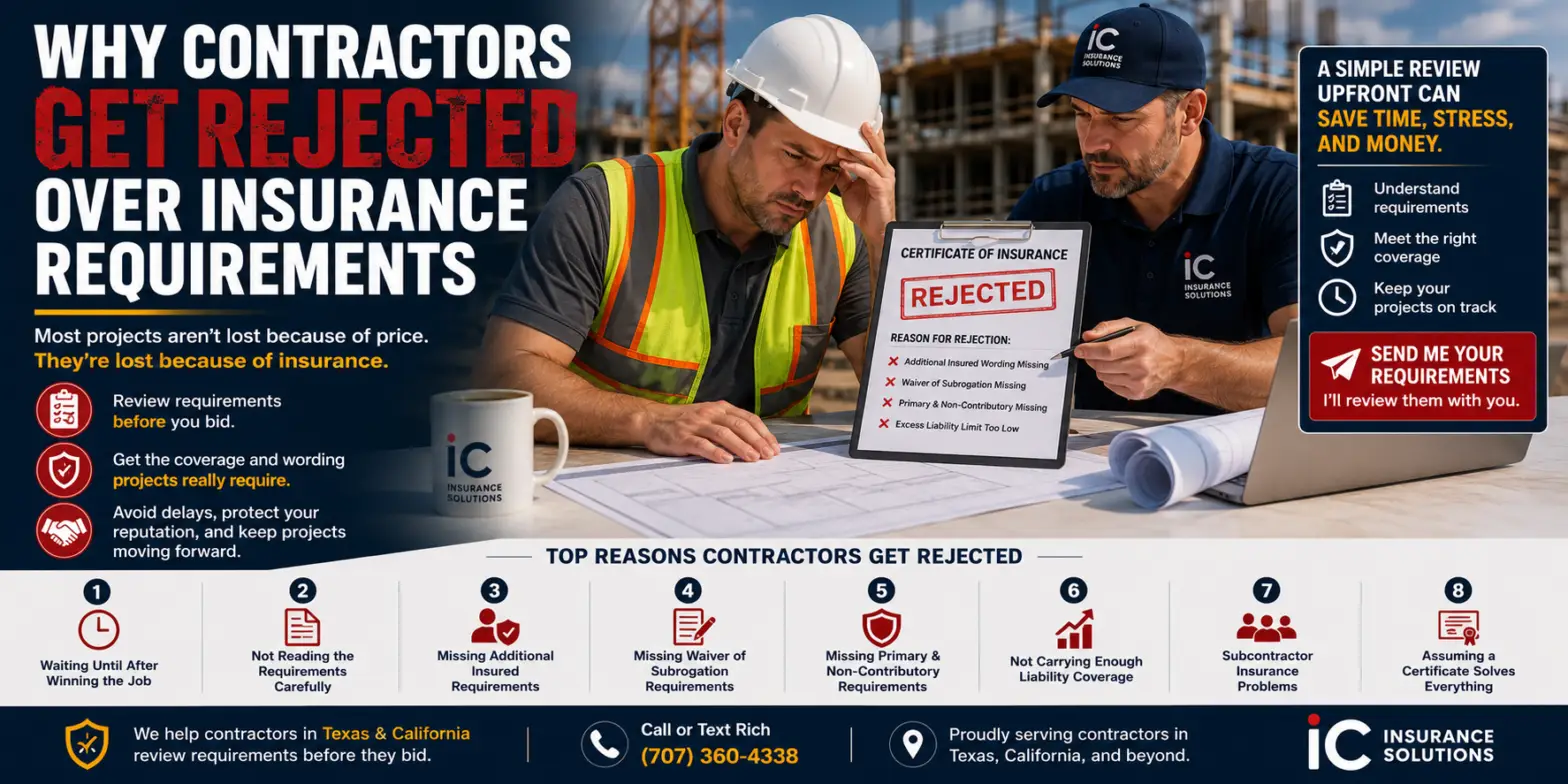
You win the job. The owner or general contractor asks for your certificate. You send it over. Then the reply comes back: “Your insurance does not meet the project requirements.”
Now the job is delayed, the start date is at risk, and you are trying to figure out what went wrong.
Most contractors do not get held up because they have no insurance. They get held up because the requirements were not reviewed early enough.
Send Me Your Requirements—I’ll Review Them
Call or Text Rich
Most rejections happen because the insurance requirements were assumed instead of verified. The contractor had coverage, but the job required specific limits, wording, endorsements, or documentation that had not been reviewed early.
The problem usually starts before the certificate is ever requested. That is why reviewing requirements before bidding is one of the smartest moves a contractor can make.
Many contractors price the work, win the project, and then look closely at the insurance requirements.
By then, deadlines are tight, certificate approval is urgent, and any gap becomes harder to fix. Review the requirements before the bid goes in, not after the award letter shows up.
Insurance requirements can show up in exhibits, general conditions, supplemental requirements, subcontract agreements, and project onboarding documents.
Contractors often study the scope and schedule but skim the insurance section. That is where expensive surprises hide. Start here: How to Read Construction Insurance Requirements Before You Bid.
Additional insured wording is one of the most common reasons a certificate gets rejected. The project may require specific endorsement wording, ongoing operations coverage, completed operations wording, or specific parties to be listed.
Review this related guide: What Is Additional Insured Coverage for Contractors?
Waiver of subrogation wording is easy to overlook because it may be buried in the contract or insurance exhibit. But if the project requires it and the certificate does not reflect it properly, approval can be delayed.
Read more here: What Is Waiver of Subrogation for Contractors?
Many projects require additional insured, waiver of subrogation, and primary and non-contributory wording together. Missing one part can delay approval even if the rest of the certificate looks fine.
Review the plain-English explanation here: Primary and Non-Contributory for Contractors.
A contractor may carry standard limits, but the project may require higher general liability limits or excess liability. That difference can affect whether the contractor qualifies for the job.
For more detail, review What Is Excess Liability Insurance for Contractors? and the General Liability service page.
Many contractors focus on their own coverage and forget that subcontractor insurance can also affect project approval. Missing certificates, expired coverage, uninsured subs, or mismatched limits can create serious problems.
Helpful resources: Using Subcontractors and Subcontractors Liability.
A certificate is proof of coverage. It is not the requirement itself.
The contract requirements control what coverage, limits, wording, and endorsements may be needed. If you need certificate help, use the pillar guide here: Contractor Certificate Insurance Help.
Related pages: Workers’ Compensation, Commercial Auto, and Builders Risk.
Texas requirements can vary widely across commercial construction, industrial projects, oil and gas, municipal work, Dallas, Houston, Austin, and the Permian Basin. Some projects are straightforward, while others require detailed review.
California projects often involve more formal documentation and more detailed requirement sections, especially on public works, education, commercial development, multi-family construction, Sacramento-area projects, and Northern California jobs.
A contractor wins a project and receives final requirements asking for additional insured, waiver of subrogation, primary and non-contributory wording, and $5M in excess liability.
The contractor assumed the certificate would be simple. But now the job needs a deeper coverage review, and the start date is getting close. That pressure could have been avoided by reviewing the requirements before bidding.
The best time to review insurance requirements is before you bid. Send them over and I’ll walk through them with you.
Send Me Your Requirements—I’ll Review Them
Call or Text Rich
Contractors are often rejected because their certificate or coverage setup does not match the project’s required limits, wording, endorsements, or subcontractor requirements.
Yes. A certificate can be rejected if it does not meet the project’s insurance requirements or if required wording is missing.
The project may be delayed, you may not be approved to start work, or you may need to adjust coverage or documentation before moving forward.
Yes. Reviewing requirements before bidding helps contractors understand the real insurance burden and avoid surprises after the job is awarded.
Yes. Missing certificates, expired coverage, uninsured subcontractors, or mismatched limits can create problems for the prime contractor and delay project approval.