You spend days putting together a bid.
You estimate labor. You price materials. You schedule equipment. You line up subcontractors. You visit the job site and review the scope of work.
The numbers look good.
The project looks profitable.
You submit your proposal and win the job.
Then the contract arrives.
At first, everything seems fine. The schedule matches what you expected. The scope looks right. The client is ready to move forward.
Then you discover something you did not plan for.
The contract requires $5 million in excess liability coverage.
It requires special endorsements.
It requires insurance wording you have not dealt with before.
Now you are trying to figure out what those requirements mean, whether your current policies meet them, and how much it will cost to comply.
The project that looked profitable a week ago suddenly looks very different.
This situation happens more often than many contractors realize.
Most contractors focus on labor, materials, equipment, and scheduling when they prepare a bid. Those things matter. But insurance requirements can also affect whether a job is truly profitable.
That is why contractors should review insurance requirements before signing a contract.
A review before you sign can help you avoid surprise costs, protect your profit margin, prevent delays, and understand the true cost of taking the job.
Many contractors assume all insurance requirements are listed in one section of the contract.
That would make life easier.
But many construction contracts are not written that way.
A contract may include a section called “Insurance Requirements.” A contractor reads that section and thinks they understand what is needed.
Then, several pages later, more insurance language appears.
It may show up in general conditions, project exhibits, subcontractor requirements, indemnification sections, or special provisions.
For example, the main insurance section may say the contractor needs $1 million in General Liability coverage. That sounds simple enough.
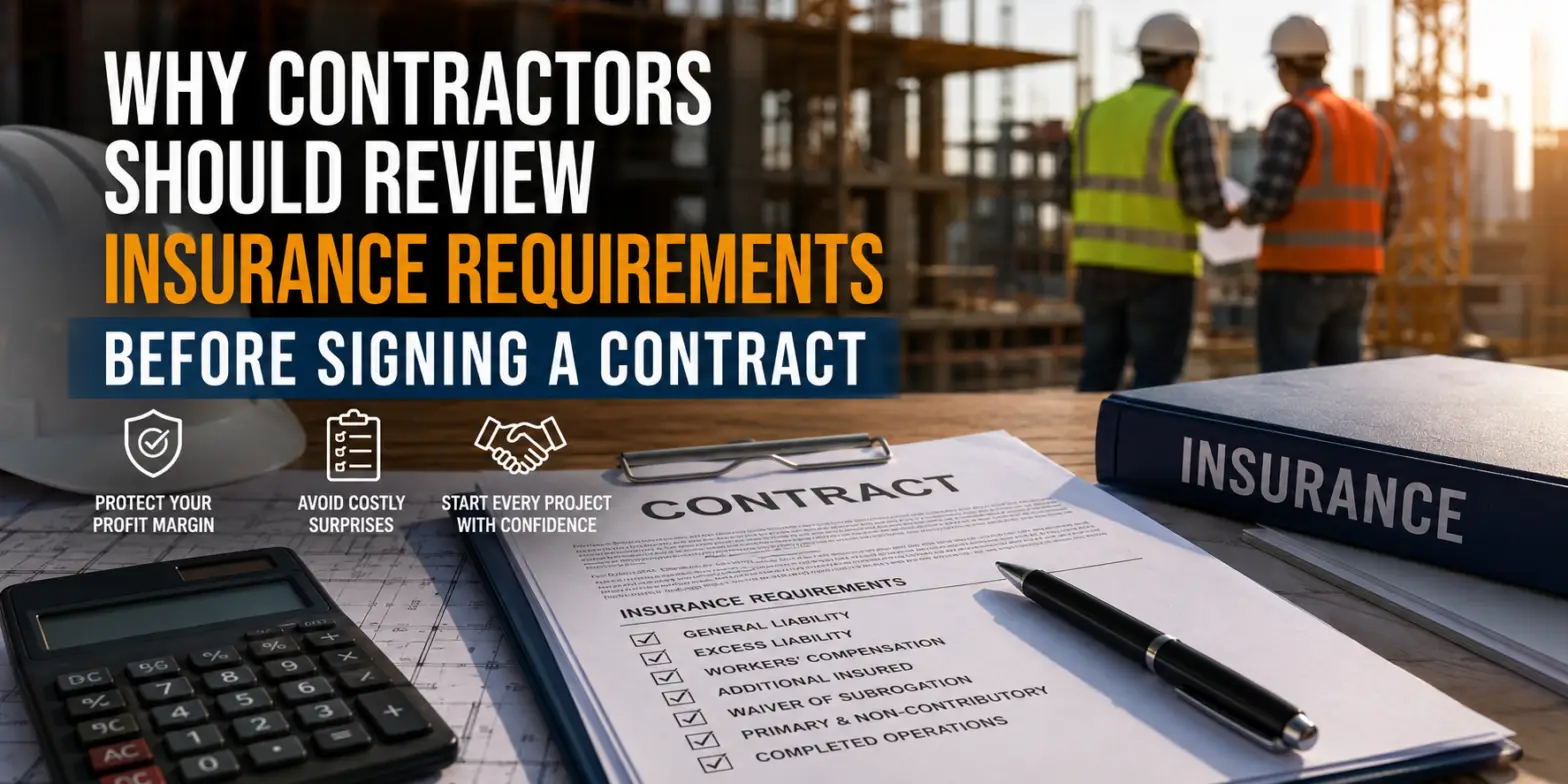
But another part of the contract may require additional insured status, completed operations coverage, waiver of subrogation wording, primary and non-contributory language, or excess liability coverage.
Those details can change what is needed to perform the job.
The issue is not always that the requirements are unreasonable. The issue is finding them after you have already committed to the project.
Construction contracts are designed to decide who is responsible when something goes wrong. Insurance requirements are part of that process. That is why they may appear in several places throughout the agreement.
A careful review before signing can help catch requirements that are easy to miss when you are focused on getting the job started.
Imagine a contractor bidding a small commercial remodel.
The project looks simple. The contractor has completed similar work many times before.
After winning the project, the contractor discovers the owner requires several million dollars in excess liability coverage.
That cost was never included in the bid.
Now the contractor faces a difficult choice.
Either absorb the expense and reduce the profit margin or try to negotiate after the contract has already been signed.
Neither option is ideal.
A review before bidding could have identified the issue much earlier.
Most contractors would never submit a bid without knowing their labor costs.
The same goes for materials.
Nobody wants to find out after signing a contract that materials cost more than expected or that extra equipment is needed.
Insurance should be treated the same way.
It is part of the cost of doing the job.
Yet many contractors assume their current policies will satisfy whatever requirements appear in the contract.
Sometimes they do.
Sometimes they do not.
Say a contractor bids a $300,000 project. After calculating expenses, the job appears to offer a healthy profit.
The contractor wins the job. Then the owner asks for coverage the contractor does not currently carry.
The owner wants higher liability limits. Special endorsements are required. New certificates must be issued.
Those costs were not included in the proposal.
The contractor still has payroll. The contractor still has equipment costs. The contractor still has material expenses.
The only thing that changes is how much profit remains at the end of the project.
That is why contractors need to know their insurance costs before they submit a bid.
A project may still make sense financially. But it is better to make that decision before signing a contract rather than afterward.
One of the most common issues we see involves excess liability coverage.
A contractor may already carry General Liability, Commercial Auto, and Workers’ Compensation coverage. They feel comfortable with their insurance program because it has worked for past jobs.
Then a new contract requires $5 million or even $10 million in excess liability coverage.
From the owner’s point of view, the requirement may make sense.
The owner may have valuable property to protect. They may have dealt with claims before. They may have legal advisors who recommend higher limits on every project.
The issue is not whether the requirement makes sense from the owner’s perspective.
The issue is whether the contractor knew about it before bidding.
If the requirement is found early, the contractor can find out what it costs and decide whether the project still works financially.
If it is found after signing, the contractor may have fewer options.
That is why comparing your current General Contractor Insurance coverage to the project’s requirements before signing can make a major difference.
You want to know what the job requires before the job requires it from you.
Many contractors believe every insurance requirement in a contract is final.
Some are.
Some are not.
Certain requirements may be required by the owner, lender, municipality, or project manager. Others may have been copied from another contract or written for a larger project.
The only way to know is to review the contract early.
Imagine a small contractor bidding a tenant improvement project.
The contract requires professional liability coverage, pollution liability coverage, and $10 million in excess liability.
The contractor’s scope of work may not justify every one of those requirements.
Before signing, the contractor can ask:
Does this requirement apply to my work?
Can the limit be reduced?
Would the owner accept different wording?
Sometimes the answer is no.
Sometimes the answer is yes.
But once the agreement is signed, the owner’s position often becomes much firmer. At that point, the contractor has already agreed to the requirements.
Reviewing early gives you a chance to ask questions while there is still room to discuss them.
When contractors are ready to start a project, it can be tempting to sign the contract and handle the details afterward.
That can create problems.
Before signing, you can ask questions. You can request clarification. You can discuss insurance requirements that do not seem to match the job.
After signing, the owner expects compliance.
If the requirements are not met, the project may be delayed. The certificate may be rejected. Special endorsements may be needed. Work may not begin until everything is approved.
That is why an Insurance Certificate for Contractors should not be treated as a last-minute task.
The certificate must match the contract requirements.
If the contract contains wording that was missed, the certificate process can quickly become more complicated than expected.
Reviewing the requirements before signing can help prevent that scramble.
Insurance requirements do more than specify coverage limits.
They often connect to indemnification language, subcontractor responsibilities, documentation rules, and risk transfer obligations.
A contractor may think they are only agreeing to provide a certificate.
In reality, they may also be accepting responsibility for situations they did not fully review.
This becomes even more important when subcontractors are involved.
Most general contractors rely on subcontractors to complete projects. That creates another layer of risk.
If subcontractors are not properly documented and insured, problems can move back to the general contractor.
That is why insurance review and subcontractor management should work together.
Subcontractors bring their own risks to a project.
If they cause damage or someone gets hurt, the general contractor does not want to absorb that responsibility because paperwork was missing or outdated.
A strong subcontractor process should focus on three areas.
Contractors should collect and track subcontractor insurance. This may include General Liability, Workers’ Compensation, Commercial Auto, and Excess Liability.
Collecting a certificate once a year is not enough. Policies expire. Coverage changes. Renewals happen.
Each subcontractor should have records that are easy to find. That may include certificates, agreements, renewal dates, and job-related paperwork.
Good documentation can help during audits, claims, and contract reviews.
The agreement between the contractor and subcontractor should clearly define who is responsible for what.
If the subcontractor causes a problem, the general contractor should not be left carrying the exposure because the agreement or insurance paperwork was weak.
Clear Subcontractor Insurance Requirements help contractors verify coverage, maintain records, and protect the business before work begins.
One mistake contractors make is assuming every project will have similar requirements.
That is rarely true.
Even repeat clients may change requirements from one project to the next.
A project completed last year may have required only standard liability coverage. The next project may require higher limits, different endorsements, and additional documentation.
Experienced contractors do not assume.
They verify.
Before signing, they ask:
What coverage is required?
Do my current policies meet those requirements?
Are special endorsements needed?
Will subcontractors need additional documentation?
Will insurance costs affect the profitability of this job?
Those questions help prevent surprises later.
They also help contractors make better decisions before committing to the work.
Online insurance providers can be useful when a contractor needs a policy quickly.
But construction contracts often require more than a policy.
Contractors may need help understanding insurance language. They may need someone to review requirements before they bid. They may need guidance on excess liability, endorsements, certificates, or subcontractor documentation.
That is where a hands-on advisor can help.
The goal is not just to provide coverage.
The goal is to help contractors understand what they are agreeing to before they commit to the project.
A review today can prevent a costly mistake tomorrow.
Construction contracts can contain insurance requirements that affect your costs, your profit margin, and your ability to start work on time.
Those requirements are not always easy to identify. They may appear in different parts of the contract. They may require coverage you do not currently carry. They may include wording that creates added obligations for your business.
That is why experienced contractors review insurance requirements before signing an agreement.
A contract review can help you identify hidden requirements, understand excess liability obligations, verify subcontractor responsibilities, and calculate the true cost of the project before bidding.
Most contractors would never bid a project without understanding labor or material costs.
Insurance costs deserve the same attention.
The best time to find an insurance requirement is before you submit your bid—not after you have signed the contract.
At Integrated Commercial Insurance Solutions, we help contractors review project requirements before they commit to the work. If you need help understanding insurance requirements, organizing subcontractor documentation, or determining what coverage may be needed for an upcoming project, we are happy to help.
Request a free review: https://icinssolutions.com/request-a-quote/
Or call 800-922-9721
Send us your job requirements before you bid. We will review them with you so you can make informed decisions, protect your profit margin, and move forward with confidence.
Reviewing insurance requirements before signing a contract helps contractors understand the true cost of a project. It can reveal additional coverage requirements, endorsement requests, or liability limits that may affect profitability. Finding these requirements early gives contractors time to plan, ask questions, and avoid costly surprises later.
Insurance requirements can appear in several parts of a contract, not just in the section labeled “Insurance Requirements.” They may also be found in general conditions, indemnification clauses, project exhibits, subcontractor provisions, and special contract terms.
If you sign first and review later, you may discover coverage requirements that increase your costs or delay the project. You may also have less flexibility to negotiate requirements because you have already agreed to the contract terms.
Excess liability coverage provides additional protection above your underlying liability policies. Property owners, developers, municipalities, and large commercial clients often require higher liability limits to protect their assets and reduce their risk exposure.
Sometimes. Some requirements are mandatory, while others may be open to discussion. Reviewing the contract before signing gives contractors an opportunity to ask questions and determine whether certain requirements can be modified or clarified.
Additional insurance requirements may increase project costs. If those costs are not included in your bid, they may reduce your expected profit. Reviewing requirements early helps contractors account for those expenses before submitting a proposal.
Many project owners require proof of insurance before allowing work to begin. If your certificate does not meet the contract requirements, the owner may reject it, which can delay the start of the project.
Yes. Subcontractors should carry their own insurance coverage and provide current documentation. This helps separate responsibilities and reduces the chance that liability will flow back to the general contractor.
Contractors should collect certificates of insurance and verify key coverages such as General Liability, Workers’ Compensation, Commercial Auto, and Excess Liability when applicable. They should also keep subcontractor agreements and other supporting documentation on file.
Every project is different. Owners, developers, lenders, attorneys, and project managers may have different expectations and risk concerns. Even projects for the same client may have different insurance requirements based on the scope of work or project value.
Contractors should review insurance requirements for every project before submitting a bid or signing an agreement. Assuming that requirements will be the same as a previous project can lead to costly mistakes.
An insurance advisor can review project requirements, identify coverage gaps, explain insurance language, and help contractors understand the costs associated with meeting contract obligations. This can help contractors make better decisions before committing to a project.
This article is a collaboration between IC Insurance Solutions, Inc and OpenAI’s ChatGPT. Created on June 13, 2026, it combines AI-generated draft material with IC Insurance’s expert revision and oversight, ensuring accuracy and relevance while addressing any AI limitations.
Construction contracts frequently require both additional insured status and waivers of subrogation, yet many contractors are unclear about how these provisions work and why they matter. This article provides a practical explanation of both concepts and helps contractors better understand common risk transfer requirements found in construction contracts.
This article offers a detailed look at how insurance requirements are used to transfer risk in commercial and construction contracts. It provides useful guidance on evaluating insurance clauses, identifying required coverages and endorsements, and understanding how contract requirements should align with the scope of work.
URL: https://contractnerds.com/how-to-assess-common-insurance-requirements-in-contracts/
For contractors who want a deeper understanding of contractual risk transfer, this resource explains how indemnity agreements, insurance requirements, and subcontractor obligations work together. It also discusses common mistakes contractors make when relying on outdated contract language or failing to review insurance requirements before signing agreements.
URL: https://www.irmi.com/PDFs/Freemiums/effective-contractual-risk-transfer-in-construction.pdf