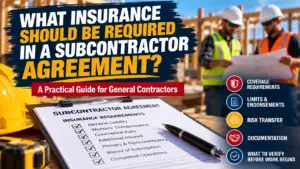
Spring and summer hit, and everything starts moving faster.
More calls come in.
More jobs get lined up.
More pressure builds to get work started and finished on time.
That usually means one thing—you bring in more subcontractors.
That part is normal.
Subcontractors help you get jobs done. They let you take on more work and keep projects moving when your schedule fills up.
But this is also where a lot of contractors run into trouble.
Not because they use subcontractors.
Because of how those subcontractors are set up.
Most jobs don’t have problems at the start. Everything looks fine. Work is moving, crews are busy, and deadlines are being met.
The problems show up later.
An audit comes in.
Someone gets hurt.
Damage happens on the job.
Or a client asks for paperwork you don’t have.
That’s when things slow down.
That’s when subcontractors can turn into a real issue.
And in most cases, it comes back to one thing:
The setup wasn’t done right.
A lot of contractors think:
“My subcontractor is responsible for their own work.”
On the surface, that makes sense.
They have their own business.
They run their own crew.
They handle their own jobs.
But when something goes wrong, it doesn’t always stay with them.
If things are not set up the right way, the problem can come back to you.
One of the biggest misunderstandings is thinking your general liability policy will take care of everything.
It won’t.
General liability has limits. It also has gaps.
If you haven’t reviewed it closely, it helps to understand what general liability actually covers for contractors:
Once you see what it does—and what it doesn’t—it becomes easier to spot where risk can slip in.
If a subcontractor is missing coverage, or there is no agreement, or nothing clearly shows who is responsible, the problem doesn’t just disappear.
It has to land somewhere.
And many times, it lands on the general contractor.
When subcontractor problems show up, they usually trace back to three areas:
Verification
Documentation
Risk transfer
When all three are handled properly, things tend to hold together.
When one is missing or weak, exposure starts to build—often without you noticing.
Most of the time, you only find it when something forces you to look.
Most contractors believe they verify their subcontractors.
And they do—at the start.
They ask for a certificate of insurance, receive it, and move on.
But that is where many stop.
The problem is that a certificate only shows what was true on the day it was issued.
It does not tell you what happens later.
Policies can expire.
They can get canceled.
They can change during the job.
If you are not checking again, you would not know.
Think about bringing on a subcontractor at the start of a job. Everything looks good. They have general liability and workers comp.
You let them begin work.
A few weeks later, their workers comp policy lapses.
You don’t see it.
Then one of their workers gets hurt on your job site.
Now the focus is not on what they had before—it’s on what they have now.
If workers comp is not active, that problem can come back to you.
This is also where audits create issues.
If you cannot show proper certificates, the auditor may treat that subcontractor like an employee.
That means their labor can be added to your payroll—and your premium goes up.
This is often when contractors start trying to understand contractor insurance requirements for jobs, because someone is now asking for proof:
Verification is not just collecting paperwork.
It’s making sure coverage is active—and stays active—while the work is being done.
Even if your subcontractor has insurance, that alone does not protect you.
You still need something in writing.
A lot of contractors work with people they trust.
They’ve worked together before. They know how each other operates.
So instead of written agreements, things get handled through conversations or quick messages.
That works—until something goes wrong.
When there is a problem, people start asking questions:
Who was responsible?
What work were they hired to do?
Who is paying for the damage?
If nothing is written down, it becomes unclear.
And when things are unclear, it often works against you.
Say a subcontractor damages part of a project.
You try to say it was their responsibility.
But there is no written agreement.
Nothing shows what they were supposed to do or what they were responsible for.
Now it becomes a dispute.
And disputes are harder to deal with when you have no records.
A simple way to handle this is to stay organized.
Keep one file for each subcontractor.
Inside that file:
That way, if something comes up, you’re not trying to piece it together later.
This is where everything comes together.
You can check insurance.
You can keep records.
But if responsibility is not clearly defined, you can still end up with the problem.
A lot of contractors assume:
“They have insurance, so it’s covered.”
That is not always true.
You need to make sure the subcontractor is clearly responsible for:
If that is not clear, you can still get pulled into the issue.
One of the biggest risks here is workers comp.
If a subcontractor does not carry workers comp and someone gets injured, that problem can come back to you.
And general liability will not cover employee injuries.
Sometimes the issue is not just who is responsible—but how big the loss is.
If something serious happens, the cost can go beyond basic limits.
That is when contractors start looking at excess liability coverage for construction jobs to handle larger losses:
Risk transfer helps keep those situations from becoming your responsibility.
Subcontractor issues usually do not show up right away.
They show up when something goes wrong.
An audit.
A claim.
A job issue.
That’s when gaps become clear.
You might find:
At that point, you are no longer setting things up.
You are dealing with the result.
That can mean higher costs, lost profit, or paying for something you did not expect.
It also affects how you bid jobs.
You need to understand your cost before you bid.
Subcontractor exposure is part of that cost.
This is not usually about carelessness.
It happens because of how work gets done.
Jobs move fast.
Decisions get made quickly.
Subcontractors are brought in to keep things moving.
There is not always time to slow down and set everything up the right way.
At the same time, many contractors were never shown how to:
So they do what works in the moment—and deal with problems later if they come up.
This does not need to be complicated.
Before bringing someone onto a job, take a moment and ask:
Is their insurance active right now?
Will it stay active during the job?
Do I have a written agreement?
Is it clear who is responsible if something goes wrong?
If you can answer yes to those questions, you are in a stronger position.
You are protecting:
Subcontractors are part of the job.
They help you move faster, take on more work, and keep projects on schedule.
But they also bring one of the most common risks contractors deal with.
Not because subcontractors are the problem—
But because it is easy to bring them in without the right setup behind them.
Most of the time, everything works fine.
Until something goes wrong.
That is when gaps show up.
Coverage is not active.
There is no agreement.
Responsibility is not clear.
And when that happens, the problem does not go away. It has to land somewhere.
Many times, it lands on the general contractor.
The good news is that this can be handled before the job starts.
When you take the time to verify coverage, keep clear records, and make sure responsibility is set the right way, you protect yourself.
Not just from problems—but from losing profit on the job.
If you are not sure whether your subcontractors are set up the right way, it is better to look at it now before something forces the issue later.
Send over what you’re working with:
https://icinssolutions.com/request-a-quote/
Or call/text 800-922-9721 anytime.
Yes. Every subcontractor should carry their own insurance.
At a minimum, that usually includes:
If they don’t have proper coverage, the risk can come back to you.
If a subcontractor doesn’t carry workers comp and someone gets injured, that claim can come back on you.
Your general liability policy will not cover employee injuries.
This is one of the most common ways contractors get exposed.
No.
A certificate only shows that coverage was active on the day it was issued.
It does not guarantee:
You need to verify and track coverage throughout the job.
You should check it:
Since policies renew at different times, it’s important to track them during the project—not just once.
Yes.
Without a written agreement, it’s hard to prove:
Verbal agreements won’t hold up in a dispute or claim situation.
Risk transfer means making sure the subcontractor—not you—is responsible for:
This needs to be clearly defined in your agreement and backed by proper insurance.
Sometimes—but not always.
Many policies:
If things aren’t set up correctly, your policy may not respond the way you expect.
During an audit, the carrier looks at how you used subcontractors.
If you can’t show proper documentation or insurance:
That can increase your premium.
If subcontractor risk isn’t handled properly, it can:
That’s why it’s important to understand this before you bid a job.
Keep it simple:
One file per subcontractor with everything in it goes a long way.
Before bringing someone on, make sure:
If those three things are in place, you’re in a much stronger position.
Before the job starts.
That’s when you still have control.
Once a claim or audit happens, it’s no longer about fixing the setup—it’s about dealing with the outcome.