Subcontractor Insurance & Risk Management
You are bringing a subcontractor onto a project. They have sent a W-9 and a certificate of insurance, and everything looks ready to go. There is still one important question: what insurance does your subcontractor agreement actually require them to maintain?
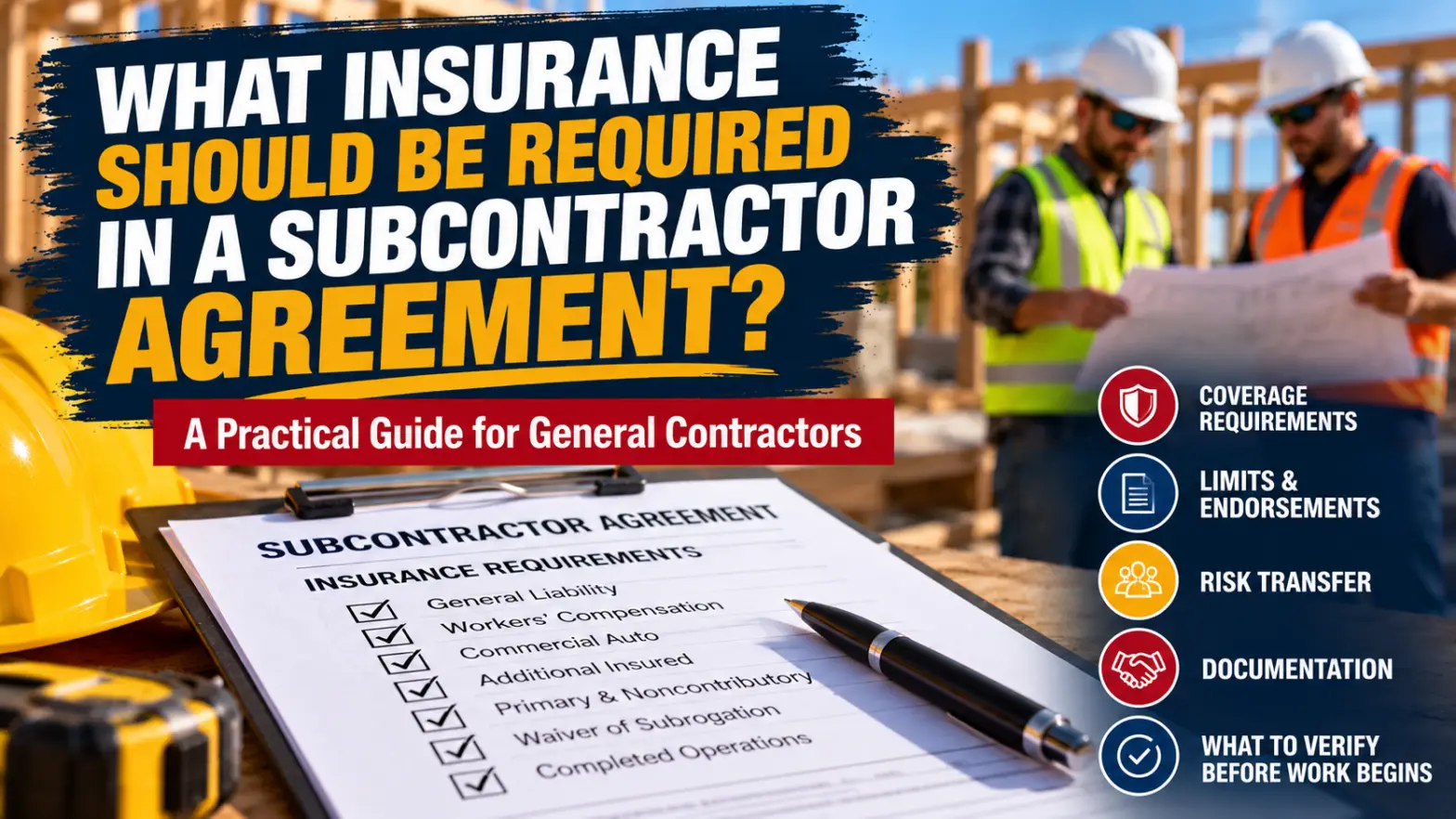
A subcontractor agreement may address required insurance types, limits, additional insured status, completed operations, primary and noncontributory wording, waiver of subrogation, and documentation requirements. The right requirements depend on the work, the project contract, the general contractor’s insurance program, and applicable law, so they should be reviewed before work begins.
The subcontractor agreement helps document what the subcontractor is expected to maintain before and during the work. That can include required insurance lines, limits, endorsements, and other insurance-related obligations tied to the project.
A certificate of insurance can help document what coverage is in force on the date it is issued, but it does not replace the subcontractor agreement, policy, or endorsements. The agreement establishes the requirement; the insurance documentation helps demonstrate whether that requirement has been met.
Read more about subcontractor certificates of insurance.
If the owner, developer, or another upstream party requires the general contractor to maintain certain protections, the GC needs to understand whether and how those requirements should be addressed with subcontractors. That is one reason it is important to review construction job insurance requirements before work begins.
The right insurance requirements should reflect the subcontractor’s real work and exposure. A subcontractor performing limited operations can present very different risks from one operating vehicles, doing design-related work, or working on a project with unusually high contractual limits.
Before deciding what needs to be addressed, ask:
General liability is commonly part of a subcontractor’s insurance requirements, but the details matter. A certificate that simply shows “general liability” does not tell you whether the limits, policy conditions, or endorsements line up with the job.
The agreement may need to address the liability limits required by the project, the GC’s insurance program, or the upstream contract. There is no single limit that is right for every subcontractor or every job.
Policies can include exclusions or conditions affecting particular trades, operations, or subcontracted work. That is why it is important to look beyond the certificate and understand what the actual policy is designed to address.
Liability can continue after a subcontractor leaves the site. If the contract requires completed-operations protection or additional insured status for completed operations, that requirement needs to be identified and documented appropriately.
Workers’ compensation is another area that deserves attention when subcontractors have employees or when project and state requirements make the coverage relevant.
A W-9 provides taxpayer information. It does not prove that a subcontractor has workers’ compensation coverage or that the coverage is current. If you are using W-9s as your main subcontractor documentation, review Does a W-9 Make Someone a Subcontractor?
If an employee of a subcontractor is injured, the facts of the relationship, the applicable state rules, and the insurance carried by the parties can all matter. Missing documentation can also become an issue during an insurance audit.
Read: Do Subcontractors Need Workers’ Compensation Insurance?
Commercial auto may be relevant when the subcontractor:
The important question is not simply whether the subcontractor “has auto insurance.” It is whether the appropriate commercial auto coverage is required for the operations being performed and whether the documentation matches that requirement.
Larger projects often require liability limits beyond what a subcontractor’s underlying policies provide. If the project calls for higher limits, that should be identified before work begins rather than after the subcontractor is already on site.
A subcontractor agreement can help document the required limit, but the GC still needs to verify that the subcontractor’s actual coverage supports what the agreement requires.
A subcontractor agreement may require the GC, owner, or other parties to be added as additional insureds under applicable liability coverage. The exact wording matters because additional insured protection depends on the policy and endorsement actually issued.
Certificate holder and additional insured are not the same thing. Being listed on a certificate does not automatically mean the party has additional insured protection.
Read: Additional Insured vs. Certificate Holder—What’s the Difference?
Primary and noncontributory wording can appear in construction contracts and subcontractor insurance requirements. In practical terms, the requirement is intended to address how applicable insurance responds when more than one policy could potentially apply. The exact effect depends on the policy wording and endorsement.
Read the full explanation of primary and noncontributory wording for contractors.
A waiver of subrogation may also appear in a subcontractor agreement or project insurance requirements. Whether it is required depends on the contract and the coverage involved. The policy endorsement matters; simply writing the phrase into an agreement does not create an insurance endorsement.
Not every subcontractor needs these coverages. The requirement should follow the subcontractor’s actual operations and the project contract.
If the subcontractor provides design, engineering, consulting, specifications, or other professional services, professional liability may become relevant to the project requirements.
If the subcontractor’s operations create an environmental exposure, pollution or environmental coverage may need to be considered. The important principle is simple: insurance requirements should follow the work and the contract, not a one-size-fits-all checklist.
Suppose the agreement requires general liability, workers’ compensation, commercial auto, excess liability, additional insured status, and a waiver of subrogation. The GC collects a certificate showing only general liability.
The GC has documentation—but not necessarily documentation showing compliance with everything required.
A subcontractor can have several policies with different renewal dates. General liability may remain active while workers’ compensation, commercial auto, or excess liability expires. That means subcontractor insurance management is not always a once-a-year paperwork exercise.
The GC should have a process for identifying missing or expired documentation and determining what needs to happen before work continues. The correct response depends on the agreement, project requirements, policies, and applicable rules.
A practical subcontractor file may include:
Rich Tygett refers to organized subcontractor records as “T files.” The point is not paperwork for paperwork’s sake. It is being able to answer three practical questions: What did we require? What did the subcontractor provide? Was it current?
A strong subcontractor process needs all three parts working together.
Verify the relevant coverage, limits, and renewal dates.
Maintain the agreement, certificates, endorsements, and renewal information in an organized file.
Establish responsibilities and insurance requirements through the appropriate contractual process.
A certificate without clear requirements can leave questions about what was expected. An agreement without verification can leave you assuming the subcontractor complied. A W-9 without either tells you very little about the insurance risk.
Before a subcontractor starts, review:
This is where problems can surface quickly. The project contract may require higher liability limits, specific additional insured wording, a waiver of subrogation, or other insurance protections that are not reflected in the subcontractor agreement.
The answer is not to guess or rewrite the contract on your own. Identify the discrepancy before the subcontractor starts, then have the appropriate insurance and legal professionals review what needs to be addressed.
Send the construction job insurance requirements for review before work starts.
Start with the subcontractors who are active now and the jobs coming up next. Work through the documentation in a practical order:
Send me your job requirements and subcontractor insurance requirements. I’ll review them with you so you can see what the project is asking for and what insurance documentation needs attention before work begins.
Send Me Your Job Requirements
Call Rich: 916-224-2270
Text Rich Anytime
Need help with a current certificate request? See contractor certificate of insurance help.
The agreement may address general liability, workers’ compensation, commercial auto, excess liability, additional insured status, completed operations, waiver of subrogation, primary and noncontributory wording, and other project-specific requirements. The right requirements depend on the work, project contract, GC’s insurance program, and applicable law.
General liability is commonly required for construction subcontractors, but the appropriate coverage depends on the work, the project requirements, and the GC’s own insurance obligations. Do not assume the same requirement fits every trade or project.
Workers’ compensation requirements can depend on whether the subcontractor has employees, state law, project requirements, and the parties’ insurance programs. The requirement and documentation should be reviewed for the specific subcontractor and job.
Many construction agreements contain additional insured requirements. Whether they apply, to whom they apply, and what endorsement is needed depends on the contract and policy. The certificate alone does not create additional insured protection.
Not by itself. A certificate can provide evidence of reported coverage, but it does not replace the subcontractor agreement, the underlying policy, required endorsements, or the verification process.
The requirement generally addresses how applicable insurance is intended to respond when more than one policy could apply. The exact effect depends on the policy and endorsement, so the actual wording should be reviewed.
A waiver of subrogation may be required by the project contract or subcontractor agreement, but it is not automatically required in every situation. The applicable policy and endorsement need to support the requirement.
Verification should follow the expiration dates of the policies you are required to track. Different policies can renew on different dates, so relying on one annual certificate collection date can leave another policy expired or missing.
The GC should identify the lapse and review the subcontractor agreement, project requirements, and insurance program before allowing the issue to remain unresolved. The correct next step depends on the specific contract, policy, and facts.
Not from an insurance and risk-management standpoint. A W-9 provides taxpayer information, but the GC may still need to verify insurance, maintain certificates and endorsements, use a written subcontractor agreement, and monitor required coverage.
Important: This article is for general informational purposes and is not legal or tax advice. Contract language, worker classification, insurance requirements, and risk-transfer provisions can vary by state, project, policy, and the facts of the working relationship. Contractual provisions should be reviewed by qualified legal counsel, and insurance requirements should be reviewed with a knowledgeable insurance professional.