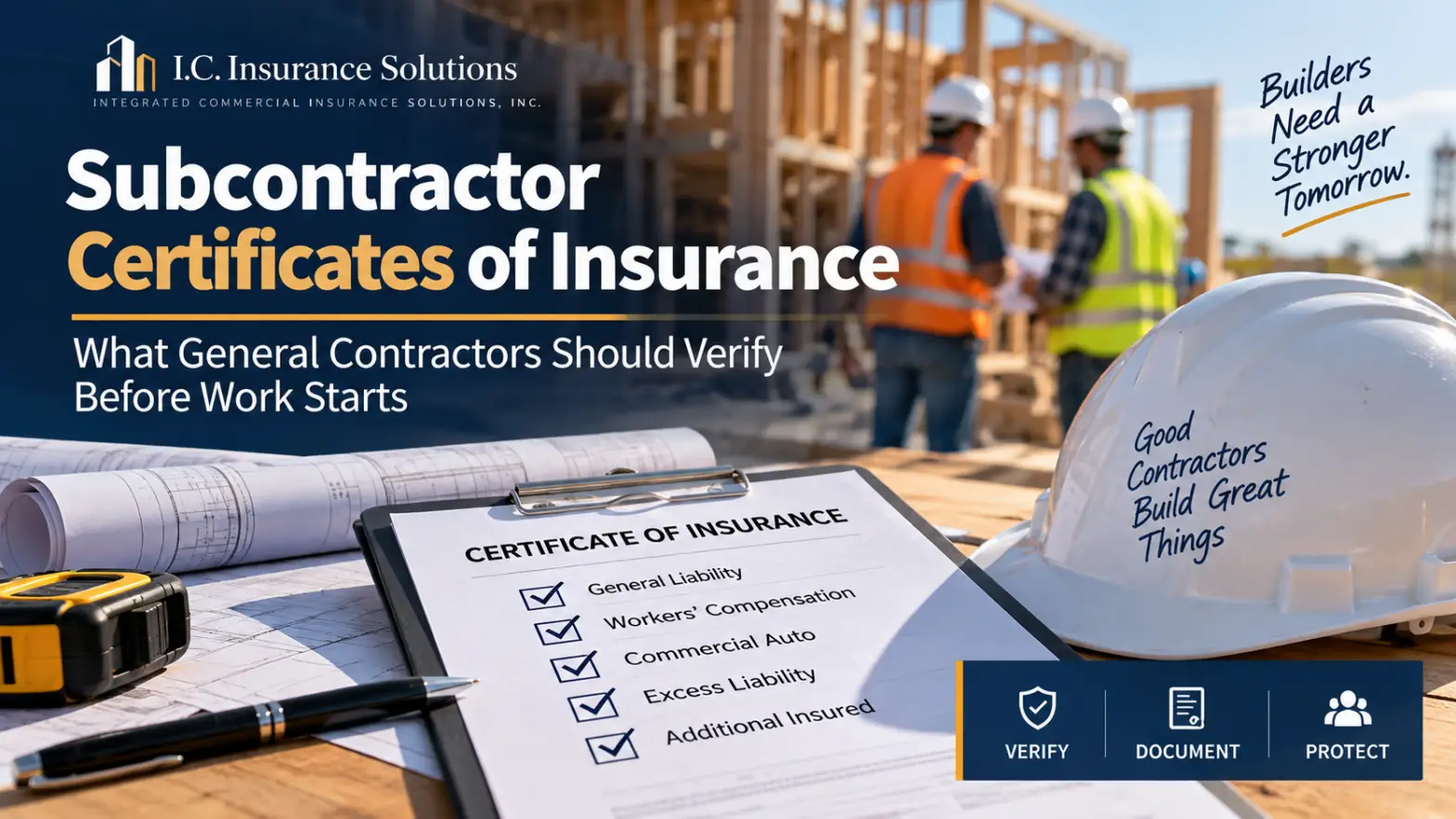
Quick answer: A general contractor should verify a subcontractor’s required insurance before work starts, including applicable general liability, workers’ compensation, commercial auto and excess liability coverage, along with policy dates, limits and required documentation. A certificate is important, but it should be reviewed in the context of the contract, project and underlying policy.
A subcontractor is scheduled to start tomorrow. They send over a certificate of insurance. It shows general liability coverage, the dates look current, and everything appears to be in order.
But is receiving the certificate enough?
A certificate of insurance is an important part of subcontractor documentation, but a general contractor needs to think beyond whether a PDF exists in the project file. You need a process for verifying the subcontractor’s required insurance, keeping documentation current, and establishing the right risk transfer before work begins.
This is one of the most common weak spots I see with contractors. The subcontractor may be qualified to do the work, everyone is trying to keep the job moving, and the paperwork gets handled informally. The problem may not show up until an insurance audit—or until something actually goes wrong on the job.
Have a subcontractor starting work and you’re not sure what documentation you need?
Send me your job requirements and what the subcontractor has provided. I’ll review them with you.
A certificate of insurance, often called a COI, is a document that summarizes insurance information shown at the time it is issued. For a subcontractor, it commonly identifies the named insured, insurance carrier, policy types, policy numbers, effective and expiration dates, limits, certificate holder, and other information included on the certificate.
A certificate summarizes insurance information. It does not replace the policy, and it cannot create coverage the underlying policy does not contain. That is why the certificate should be reviewed alongside the actual job requirements and any endorsements the contract calls for.
Read how contractor certificate of insurance requirements are reviewed before a job starts.
There is no one certificate that automatically fits every subcontractor and every project. The coverage you need to verify depends on the work, your subcontractor agreement, the project requirements, and the policies involved. A subcontractor may also carry several separate lines of insurance, and those policies may not all renew on the same date.
Start by verifying the subcontractor’s general liability information. Confirm that the correct business is shown, review the policy dates and limits, and make sure the documentation corresponds with the work the subcontractor is actually performing. Your own contract or policy may also impose requirements for subcontracted work.
Learn more about contractor general liability coverage and the exclusions that can matter on a job.
Workers’ compensation deserves separate attention. If a subcontractor’s employee is injured, you do not want to discover after the fact that the coverage you expected was missing, expired, or did not satisfy the requirement. Workers’ compensation rules vary by state and by circumstance, so verify what applies to the subcontractor and the job instead of assuming an exemption.
Review workers’ compensation coverage for contractors. You can also read Do Subcontractors Need Workers’ Compensation Insurance?
Do not assume an auto exposure falls under general liability. If the subcontractor is using vehicles as part of the work and commercial auto is required by your agreement or the project, verify it separately.
See contractor commercial auto coverage.
Some contracts require limits above the underlying policies. If excess liability is part of the subcontractor requirement, verify the limit and the applicable underlying coverage rather than assuming the general liability certificate alone satisfies the job.
Learn about excess liability insurance for contractors.
This is where a lot of otherwise good subcontractor procedures break down.
A subcontractor may have general liability, workers’ compensation, commercial auto and excess liability. Those policies can have different renewal dates. If you collect one general liability certificate today and never look at the file again, another required policy could expire while the subcontractor is still working for you.
The practical rule: treat subcontractor insurance verification as an ongoing tracking process, not a one-time paperwork exercise.
That means tracking the expiration dates for every line of coverage you require, requesting updated documentation as renewals occur, and making sure the current file reflects the subcontractor who is actually on your job.
The certificate should not be the only document defining the relationship. A written subcontractor agreement can help establish the responsibilities between the general contractor and subcontractor, including insurance obligations and risk-transfer requirements. The agreement itself should be reviewed by the appropriate legal professional for your business and jurisdiction.
A construction contract may require more than a certificate. Depending on the job, the requirement may refer to additional insured status, primary and noncontributory wording, waiver of subrogation, completed operations coverage, or other endorsements. The important point is not to assume that wording on a certificate changes the underlying policy.
For more detail, see Additional Insured vs. Certificate Holder: What’s the Difference? and What Does Primary and Non-Contributory Mean for Contractors?
Your own client may have insurance requirements that affect how you use subcontractors. If the contract requires certain limits, endorsements, or risk-transfer provisions, determine whether those obligations also need to be addressed with your subs before they start work.
Review the construction job’s insurance requirements before the work begins.
A certificate belongs inside a larger process. I organize that process around three pillars: Verification, Documentation and Risk Transfer.
Collect and monitor the insurance that applies to the subcontractor and the job. Depending on the requirement, that may include:
Keep the records organized. That may include:
I recommend keeping an organized “T file” for each subcontractor so you are not hunting through old email chains when an audit, renewal, certificate request or claim brings the documentation back into focus.
The goal is to clearly establish responsibility between the GC and the subcontractor. Depending on the relationship and contract, this may involve:
See the full subcontractor insurance and risk management process for general contractors.
One of the common places missing subcontractor documentation surfaces is at audit. If you cannot document the subcontractor relationship or the insurance that was in place, the exposure may be treated differently under the terms of your policy and audit, which can result in additional premium depending on the circumstances.
Read Can One Missing Certificate Cost You Thousands? Unfortunately, Yes for a closer look at the audit problem.
The larger concern is what happens when there is property damage, an injury, or another loss and you discover that the subcontractor documentation or expected coverage was not in place. The time to find that out is before the subcontractor starts—not after the loss.
An injury involving a subcontractor’s employee is one reason workers’ compensation verification matters. Do not assume that calling someone a subcontractor or having a W-9 settles the insurance question. Review the insurance and contractual requirements that apply to the relationship.
No. A W-9 is tax documentation. It is not an insurance certificate and it does not substitute for an insurance policy, a subcontractor agreement, or a required endorsement.
W-9 ≠ Certificate of Insurance ≠ Subcontractor Agreement ≠ Policy Endorsement
Each document serves a different purpose. If you use subcontractors regularly, your process should account for all of them where they apply rather than treating one piece of paperwork as proof that every risk-management step has been handled.
Use this as a review checklist—not as a universal list of insurance requirements. The correct requirements depend on your project, contract, policy, subcontractor and jurisdiction.
The goal is not to collect another piece of paper. The goal is to know that the subcontractor documentation and insurance line up with the risk you are bringing onto the job.
You do not need to organize everything perfectly before you call. Send what you have, and we can work through it together. Helpful documents may include:
Send me your job requirements—I’ll review them with you.
If a subcontractor is starting work, send the certificate and the job requirements too. We can look at the whole picture instead of one document in isolation.
Collect a current certificate that reflects the insurance required by your subcontractor agreement, construction contract and project. Depending on the work, that may include general liability, workers’ compensation, commercial auto and excess liability. The certificate should then be reviewed alongside any required endorsements and contract language.
Do not rely only on a once-a-year collection routine. Different policies can have different expiration dates. Track the effective and expiration dates shown for each required line of coverage and obtain updated documentation when coverage renews or changes.
No. A certificate summarizes insurance information; it does not replace the policy or create coverage that the policy does not contain. Job requirements may also call for specific endorsements, limits or wording that need separate verification.
Workers’ compensation requirements depend on the jurisdiction, the subcontractor’s circumstances and the project. If workers’ compensation is required by your contract, your policy or applicable law, verify it before work begins rather than assuming the subcontractor is exempt.
That depends on the contract, project requirements and the available policy endorsement. A certificate may show information about additional insured status, but the actual policy endorsement is what should be reviewed when additional insured coverage is required.
No. A W-9 is tax documentation. It does not verify insurance, replace a subcontractor agreement, establish additional insured status or create risk transfer by itself.
An expired policy can create a documentation and coverage gap. Track renewal dates for each required line of coverage and obtain updated documentation before the old policy expires whenever possible.
Allowing work to begin before required insurance documentation is verified can leave you without the documentation or risk transfer you expected. Review the project requirements, subcontractor agreement and your own policy before deciding how to proceed.
The subcontractor is ready. The schedule is tight. Everyone wants to keep the project moving. That is exactly when it is easiest to accept a certificate, drop it into a folder and move on.
A better process is simple: verify the coverage, document the relationship, establish the risk transfer, and keep the records current.
If you are unsure what a subcontractor should provide for a particular job, do not guess. Send the requirements and the documents you have. We will review them together.
Send me your job requirements—I’ll review them with you.
Call or text me anytime: 916-224-2270.