You have the subcontractor lined up. The schedule is set. Then the general contractor says: “We need their certificate of insurance before they can start.”
The subcontractor may have insurance, but the real question is whether it meets the project requirements.
This guide explains what insurance subcontractors usually need before starting work in Texas and California.
Send Me Your Requirements—I’ll Review Them
Call or Text Rich
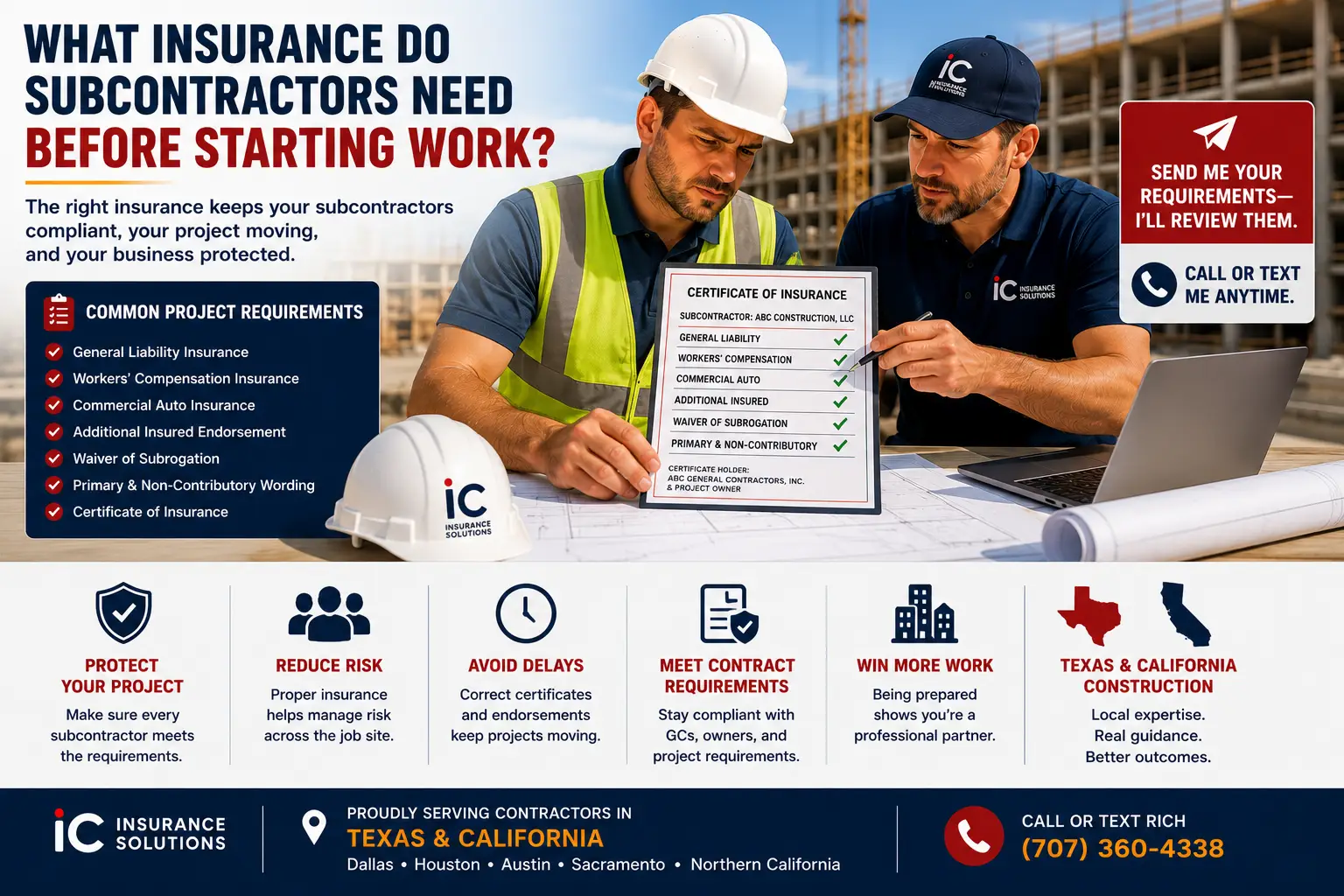
Key Takeaways
- Most commercial projects require subcontractors to provide proof of insurance before starting work.
- General liability is almost always required.
- Workers’ compensation, commercial auto, and additional insured wording are commonly requested.
- Waiver of subrogation and primary and non-contributory wording may also be required.
- Requirements should be reviewed before the subcontractor mobilizes.
- Send me your requirements—I’ll review them.
Why General Contractors Require Subcontractor Insurance
General contractors carry responsibility for the project as a whole. They need to know that every subcontractor coming onto the job site has coverage that lines up with the contract requirements. Paying someone as a 1099 or collecting a W-9 does not replace insurance verification.
Here’s what general contractors should know about W-9s and subcontractors.
Subcontractor insurance helps manage risk, satisfy owner requirements, and keep the job moving without certificate delays.
General Liability Insurance
General liability is one of the most common subcontractor insurance requirements. It may help address third-party bodily injury, property damage, and completed operations exposure tied to the subcontractor’s work.
Learn more on the
General Liability service page.
Workers’ Compensation Insurance
Many projects require workers’ compensation before anyone steps on site. In Texas, workers’ comp may not be universally required by law, but it is often required by contract. In California, requirements are generally stricter for employers and many projects require proof before work begins.
Review the
Workers’ Compensation page for more context.
Commercial Auto Insurance
If subcontractors use company vehicles, pickups, vans, trucks, hired vehicles, or non-owned vehicles for the project, commercial auto insurance may be required.
See the
Commercial Auto page.
Once the required coverage lines are confirmed, review
what to verify on a subcontractor’s certificate of insurance before it is submitted.
Additional Insured Requirements
Many subcontract agreements require the subcontractor to name the general contractor and sometimes the owner as additional insured. This is not the same as simply listing them as certificate holder.
Read:
What Is Additional Insured Coverage for Contractors?
Waiver of Subrogation Requirements
Waiver of subrogation wording is common in subcontract agreements and certificate requests. Contractors should look for it before certificates are submitted.
Read:
What Is Waiver of Subrogation for Contractors?
Primary and Non-Contributory Requirements
Primary and non-contributory wording often appears alongside additional insured status. Missing this wording can delay certificate approval.
Read:
Primary and Non-Contributory Explained
Certificate of Insurance Requirements
The certificate itself is only proof of coverage. It must line up with the actual project requirements, including certificate holder information, limits, endorsements, and wording.
Start with the pillar guide:
Contractor Certificate Insurance Help.
Common Insurance Mistakes Subcontractors Make
- Waiting until the last minute to request a certificate
- Assuming prior project requirements are the same
- Missing additional insured endorsements
- Carrying insufficient limits
- Using expired certificates
- Ignoring contract wording
Related guide:
Why Contractors Get Rejected Over Insurance Requirements.
Texas vs. California Subcontractor Requirements
Texas Projects
Texas subcontractor requirements vary by owner, general contractor, and project type. Larger commercial, industrial, municipal, Dallas, Houston, and Austin projects often require stronger documentation and higher limits.
California Projects
California projects often involve more detailed insurance documentation, especially in Sacramento, Northern California, public works, education, multi-family, and healthcare projects.
Subcontractor Insurance Checklist Before Starting Work
- Review the subcontract agreement.
- Verify liability limits.
- Confirm workers’ compensation requirements.
- Review commercial auto requirements.
- Verify additional insured endorsements.
- Confirm waiver of subrogation wording.
- Verify primary and non-contributory wording.
- Review certificate holder information.
- Submit certificates early.
- Ask questions before arriving on site.
Frequently Asked Questions
What insurance do subcontractors need?
Most subcontractors need general liability, and many projects also require workers’ compensation, commercial auto, additional insured wording, waiver of subrogation, and primary and non-contributory wording.
Do subcontractors need general liability insurance?
Yes. General liability is one of the most common requirements before subcontractors start work.
Do subcontractors need workers’ compensation?
Often, yes. Requirements depend on the state, contract, and business structure.
Can a subcontractor start work without a certificate?
Many commercial projects will not allow a subcontractor to start until the certificate is approved.
Are requirements different in Texas and California?
Yes. Texas requirements vary widely by project, while California projects often involve more detailed documentation and compliance expectations.