You’ve just won a new construction job. Your crew is ready, your subcontractors are lined up, and you’ve ordered the materials. Everything looks good for a Monday start.
Then the project owner asks for a certificate of insurance.
You’ve sent certificates for other jobs, so you don’t expect a problem. But this time, the owner rejects it.
The contract requires $3 million in excess liability coverage, and your current insurance doesn’t meet that requirement. The owner also needs an additional insured endorsement that hasn’t been added to your policy.
Now you’re making phone calls instead of getting ready for the job.
Your crew may have to wait. Your subcontractors might need new start dates. You may also need coverage you didn’t include in your original job estimate.
The frustrating part? These problems could have been caught earlier.
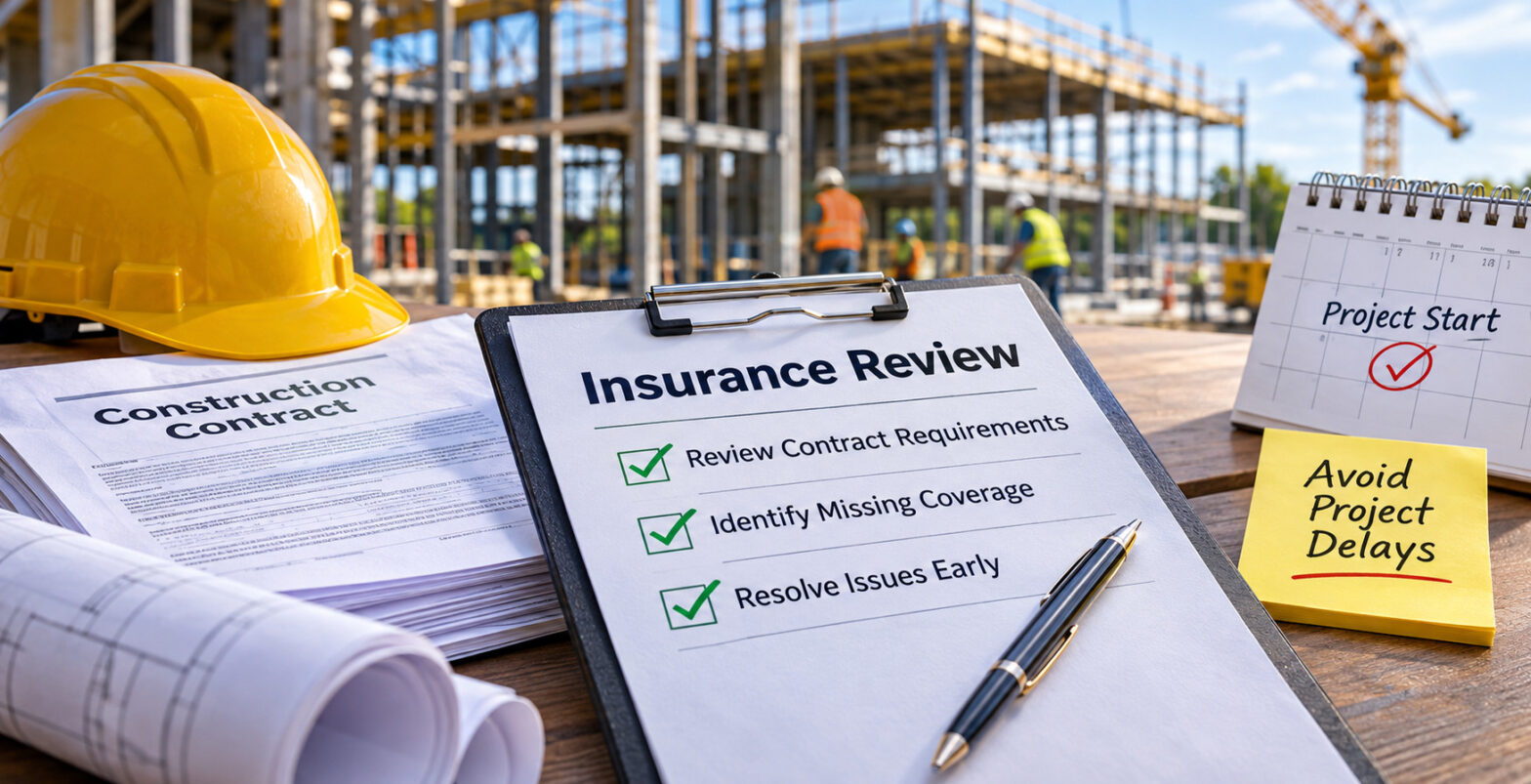
A quick insurance review can help you find missing coverage, understand contract requirements, and address problems before they delay your project.
The best time to review your insurance is before you bid on a job or sign a contract. That gives you time to understand what the project requires and whether your current policies meet those needs.
Most contractors know they need insurance. Problems often begin when a new project requires coverage their current policies don’t provide.
A project owner may require higher liability limits, special policy wording, or coverage for certain types of work.
For example, your general liability policy may have a $1 million limit. That might be enough for many of your regular jobs. But a larger project may require $2 million or more.
The owner might also ask to be named as an additional insured. This means the owner may receive certain protection under your policy for claims related to your work, depending on the policy terms.
If you don’t have the required coverage or endorsements, the owner may not allow work to begin.
Think about a contractor preparing to start a store renovation. The crew is scheduled for Monday, and the first delivery is set for that morning.
On Friday, the owner notices that the required additional insured endorsement is missing.
The contractor calls the insurance agency, but the request must go to the insurance company for review. The company may need more information before approving the change.
The contractor may not receive approval before Monday. Now the job is delayed. Workers need new schedules, and the owner wants to know when work can begin.
This is why insurance should be part of project planning, not something you handle only when someone asks for a certificate.
When you prepare a bid, you account for labor, materials, equipment, and subcontractors. You also calculate how much profit you expect to make. Insurance requirements should be part of that process.
Let’s say you’re bidding on a commercial building project. You already have general liability, workers’ compensation, and commercial auto insurance. You assume those policies will meet the owner’s requirements.
After you win the job, you learn that the contract requires more excess liability coverage than you carry.
Now you need to find out whether that coverage is available and how much the added expense will be. If you didn’t include that expense in your estimate, it could reduce your expected profit.
Reviewing the requirements before bidding gives you time to spot these issues. You can talk with your insurance professional, learn what changes may be needed, and make a more informed decision about the job.
Insurance requirements aren’t always listed in one place. Some contracts have a section called “Insurance Requirements.” Others spread those rules across several sections.
You may find them in the general conditions, special terms, insurance forms, or attachments.
One section might list the required liability limits. Another might explain who must be named as an additional insured. A separate page may state how long coverage must remain in place after the work is finished.
If you review only one section, you could miss an important requirement. That’s why it’s helpful to send the full contract and all insurance attachments to your insurance professional.
For more information, review our page on construction job insurance requirements.
Not every insurance requirement will fit the work you’re doing. For example, suppose you’re hired to renovate a building using plans prepared by an architect.
The contract requires professional liability insurance, but you’re not providing design or engineering services. You can ask the owner whether that requirement applies to your part of the job.
The owner may agree to change it or may decide to keep it. Either way, it’s better to ask before signing.
Your insurance professional can explain how the requirement relates to your coverage. A lawyer can help with questions about the contract’s legal terms.
Having insurance doesn’t always mean you’re covered for every type of work.
A contractor may carry the same policies for years without checking whether they still fit the business. As your company grows, you may take on larger jobs, use more subcontractors, or begin new types of work. Those changes can bring new risks.
An insurance review compares your existing coverage with what the next project requires.
General liability insurance is one of the main policies contractors carry. It can help with certain claims involving injuries to other people or damage to someone else’s property.
But it doesn’t cover every problem that can happen on a job.
Suppose you’re installing custom cabinets in a commercial building. During installation, you accidentally damage the cabinets you’re working on.
You may assume your general liability policy will cover the damage. However, many general liability policies have exclusions that limit coverage for damage to your own work or property you’re working on.
Whether the damage is covered depends on the policy terms and what happened. Other possible coverage gaps involve tools, equipment, pollution, design work, or subcontractor operations.
That’s why reviewing the actual policy matters. Two contractors may have the same liability limits but different coverage because of their policy terms and exclusions.
Our page on contractor general liability insurance explains how this coverage relates to construction work.
Larger projects often require more liability coverage. You may have $1 million in general liability insurance, while a new contract requires several million dollars in total protection.
Excess or umbrella liability insurance may help meet that requirement. These policies can provide higher limits above certain other policies, but they don’t all work the same way.
Some have different exclusions or rules about which underlying policies must be in place.
Your insurance professional can review the contract and help determine what coverage may be available. Doing this before you accept the job gives you time to plan for any added expense.
General liability isn’t the only insurance a construction company may need.
If you provide design services, professional liability insurance may be needed for certain mistakes related to that work. If your operations create pollution risks, you may need pollution liability coverage.
If you move tools and equipment between job sites, inland marine insurance may help protect covered property. Builders risk insurance may help cover certain types of damage to a building while construction is underway.
Workers’ compensation and commercial auto insurance also deserve attention as your company changes. For example, if you start using employee-owned vehicles for work, your current auto policy may not address every risk.
You don’t need every policy for every job. The goal is to understand what your work requires and where your current insurance may fall short.
General contractors need to review more than their own insurance. Subcontractors can create problems when their coverage is missing, expired, or doesn’t meet the contract requirements.
Imagine you’re managing a commercial renovation. Your electrical subcontractor is scheduled to start next week.
You check the insurance file and discover that the subcontractor’s workers’ compensation policy expired last month. Now you need updated proof of coverage before the subcontractor begins work.
If the issue can’t be resolved in time, the electrical work may be delayed. That delay could also affect other trades waiting to complete their work.
Missing subcontractor insurance can cause more than scheduling problems. Depending on the situation, it may lead to added liability or insurance audit expenses for the general contractor.
A general contractor shouldn’t assume that hiring someone as a subcontractor removes all responsibility for that person’s work.
A good subcontractor insurance process has three parts: verification, documentation, and risk transfer.
Verification means checking coverage. Collect proof of the insurance each subcontractor is required to carry. This may include general liability, workers’ compensation, commercial auto, and excess liability. Check when each policy expires. One certificate may not show when every policy needs to be renewed.
Documentation means keeping good records. Keep signed subcontractor agreements, certificates, and required endorsements in an organized file. Some contractors use separate “T files” for each subcontractor so they can find documents when needed. A W-9 is useful for tax records, but it doesn’t prove that a subcontractor has the right insurance.
Risk transfer means making responsibilities clear. Subcontractor agreements should explain who is responsible for certain risks. They may include insurance limits, additional insured requirements, and terms about responsibility for certain claims. These terms should match the work being performed and follow applicable laws.
You can read more about subcontractor insurance and risk management.
Checking these details before subcontractors arrive can help prevent last-minute problems.
An insurance review starts with a simple question: Does your current coverage meet the requirements of the job? To answer it, your insurance professional needs to understand the project and review your documents.
Send the construction contract and any insurance attachments. Include your current policies, certificates, and endorsements if you have them.
It also helps to explain the work you’ll perform, where the job is located, when it starts, and whether you’ll use subcontractors. These details help your insurance professional understand the project and its insurance requirements.
Next, your insurance professional compares the contract with your current policies. The review looks at coverage types, limits, exclusions, and required endorsements.
For example, the contract may require additional insured coverage for completed operations. This relates to certain claims that may arise after your work is finished.
If your policy doesn’t provide the required protection, that issue needs attention before you submit the final insurance documents.
Not every problem means you need another policy. Sometimes the coverage is already in place, but the certificate needs to be updated. Other times, the contract wording needs clarification.
A larger problem may involve missing coverage, limits that are too low, or an exclusion that affects the work. The review helps you understand which issues involve paperwork and which may require changes to your insurance.
Once you know what needs attention, you can discuss the next steps. You may need an endorsement, additional coverage, updated subcontractor documents, or clarification from the project owner.
Some requests can be handled quickly. Others need approval from an insurance company. Starting early gives you more time to work through these questions.
A certificate of insurance provides information about insurance policies. It doesn’t create coverage.
For example, listing an owner’s name on a certificate doesn’t automatically make that owner an additional insured. The policy must provide the required protection.
A certificate also can’t raise your liability limits or remove an exclusion. The goal isn’t just to send a certificate. It’s to make sure the insurance behind it meets the project’s requirements.
An insurance review can help you avoid problems that affect both your schedule and your expected profit.
Think about two contractors bidding on similar jobs. The first contractor sends the insurance requirements to an insurance professional before preparing the final estimate.
The review shows that the project needs additional excess liability coverage. The contractor checks the available options and includes the expected insurance expense when planning the job.
The second contractor doesn’t review the insurance requirements. After winning the job, the contractor discovers the same coverage requirement.
Now the second contractor must arrange coverage under a deadline. The added expense wasn’t included in the original estimate.
Both contractors may need the same protection, but the first had more time to plan.
Early reviews can also help with scheduling. If you know what documents the owner needs, you can work on them before your crew is ready to start.
You can check subcontractor certificates, request endorsements, and ask questions while there’s still time.
An insurance review won’t prevent every delay. Weather, labor shortages, and material problems can still affect a job. But it can help prevent insurance problems that could have been caught earlier.
The best time to review your insurance is before you’re facing a deadline.
Start before bidding on a project, especially when the work is larger or different from your usual jobs.
Request a review when you receive a contract with insurance terms you don’t understand.
You should also review your coverage when your business changes. Hiring employees, taking on larger jobs, working in another state, or using more subcontractors may change your insurance needs.
If a project owner rejects your certificate, ask your insurance professional to find out why. The problem may be missing information. It may also be a coverage issue that needs more attention.
Don’t wait until the morning your crew is supposed to arrive.
Construction projects already have enough things that can go wrong. Insurance requirements shouldn’t become a surprise after you’ve scheduled your crew and made plans to start.
A quick insurance review can help you understand what the contract requires, check for missing coverage, and find problems while there’s still time to address them.
It can also help you plan for insurance expenses before you commit to a job.
At Integrated Commercial Insurance Solutions, Inc., we help contractors review project requirements, understand their policies, and identify coverage that may need attention.
You don’t have to sort through the insurance language alone.
Send us your job requirements—we’ll review them with you.
Request a quote or call 800-922-9721 to talk about your contractor insurance needs.
Taking care of these details before the job starts can help you spend less time dealing with insurance problems and more time getting the work done.
An insurance review helps contractors check whether their current policies meet the project’s requirements. It can identify missing coverage, limits that are too low, or endorsements that need attention. Finding these issues early gives contractors more time to address them before work begins.
Common problems include insufficient general liability limits, missing additional insured endorsements, expired subcontractor policies, and missing excess liability coverage. A project owner may delay approval until the contractor provides the required insurance documentation.
Contractors should provide the construction contract, insurance requirements, current policies, certificates of insurance, and relevant endorsements. Details about the scope of work, project location, subcontractors, and planned start date are also helpful.
Yes. A general liability policy may be active but still lack the limits or endorsements required by the contract. Some projects also require other types of insurance, such as excess liability, professional liability, or pollution liability.
Not necessarily. A certificate provides information about existing insurance, but it doesn’t change the policy or create new coverage. Contractors should confirm that the actual policies and endorsements meet the contract’s requirements.
Missing or expired subcontractor insurance can delay work and create financial risks for the general contractor. Depending on the circumstances, it may also lead to insurance audit expenses or added liability. Checking subcontractor coverage before work begins helps reduce these risks.
Yes. A review before bidding can identify coverage requirements that may create added expenses. Contractors can then account for those expenses when preparing estimates instead of discovering them after accepting the job.
The best time is before submitting a bid or signing a construction contract. Contractors should also request reviews when taking on larger projects, entering new types of work, hiring employees, or receiving unfamiliar insurance requirements.
This article is a collaboration between IC Insurance Solutions, Inc and OpenAI’s ChatGPT. Created on Nov 11, 2026, it combines AI-generated draft material with IC Insurance’s expert revision and oversight, ensuring accuracy and relevance while addressing any AI limitations.
American Institute of Architects (AIA)
This widely used contract document explains the roles and duties of owners, contractors, and architects. Article 11 addresses insurance and bonds, making it useful for understanding how insurance obligations fit into construction contracts.
ACORD
This standard certificate form helps construction professionals understand what insurance information a certificate reports and why it doesn’t replace policy terms or endorsements. It’s especially relevant when reviewing certificate requirements and avoiding documentation errors.
Source: https://www.acord.org/standards-architecture/acord-forms
Occupational Safety and Health Administration (OSHA)
This federal enforcement policy explains how safety responsibilities can extend across multiple employers on a construction site. Although it doesn’t address insurance coverage directly, it offers useful context for general contractors managing subcontractor responsibilities and job-site risks.
Source: https://www.osha.gov/enforcement/directives/cpl-02-00-124