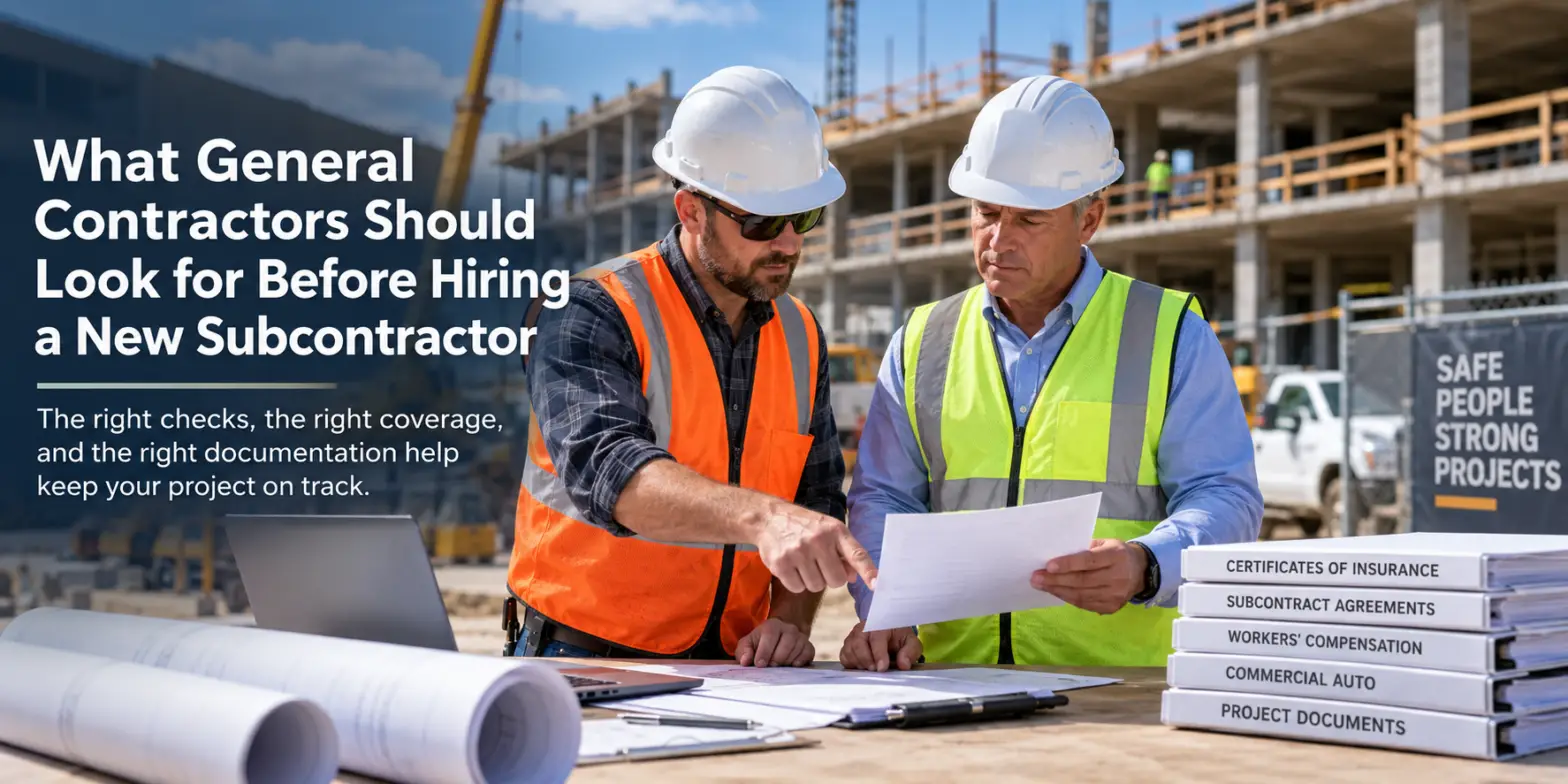
A new project is moving fast, and you need another crew. Someone gives you the name of a subcontractor who does good work. They have the right experience, enough workers, and an opening in their schedule. Better yet, they can start Monday.
It may be tempting to shake hands, collect a W-9, and put them to work.
Before they step onto the job site, though, you need answers to some basic questions.
Does the subcontractor have current insurance? Do they carry workers’ compensation? What about commercial auto coverage if they use trucks for the job? Do you have a written subcontract agreement? If you already have their insurance records, are those records still current?
You want answers to these questions before work begins. You do not want to start looking for paperwork after an injury, property damage, or insurance audit.
A good subcontractor process has three main parts: verification, documentation, and risk transfer.
Verification means checking the insurance you require. Documentation means keeping certificates, agreements, endorsements, and other records. Risk transfer means making it clear who is responsible for the subcontractor’s work and what insurance the subcontractor must carry.
Together, these three steps give general contractors a practical way to manage subcontractors before work starts and while the job is underway.
General contractors depend on subcontractors. You may need electricians, plumbers, roofers, concrete crews, framers, painters, or many other trades to complete a project.
The subcontractor may be a separate business, but their work can still create problems for your project.
Think about what can happen on a normal construction site. A subcontractor could damage property. One of their workers could get hurt. A truck could be involved in an accident while hauling materials. You could also reach an insurance audit and be asked to provide proof of insurance for the subcontractors you used.
Simply calling someone a subcontractor does not answer all the insurance and responsibility questions that can follow.
This is why I do not recommend relying on a W-9 alone. A W-9 serves a purpose, but it is not an insurance policy, a certificate of insurance, or a subcontract agreement. It does not prove that the subcontractor has workers’ compensation. It does not tell you whether their commercial auto insurance is still active. It also does not explain who is responsible if something goes wrong.
Your own general liability policy should not be treated as a safety net for everything a subcontractor does, either. Contractor policies can have conditions and exclusions that affect subcontracted work. General contractors who use subs should understand their own contractor general liability insurance and what the policy says about subcontracted work.
A better approach is to create the same process for every new subcontractor: check their insurance, put the relationship in writing, keep good records, and track those records for as long as you continue using the subcontractor.
One of the first documents to request is a current certificate of insurance.
Most general contractors already know about certificates because project owners often ask them for one. You get a new job, receive the insurance requirements, and need to show that you carry the required coverage.
When you hire a subcontractor, the roles change. Now you are the one asking for insurance information.
A certificate can show useful details about a subcontractor’s insurance. It may list the business name, insurance company, policy type, policy number, coverage dates, and limits.
Getting the certificate, however, is only the first step. You also need to review it.
Suppose you have worked with the same roofing subcontractor for several years. You know the owner, and their crew does good work. You used them six months ago, so you already have a certificate in your files.
A new roofing job comes up. Someone pulls out the old certificate and sees that the general liability policy has not expired. It may seem like you are ready to go.
But what about workers’ compensation? What about commercial auto? Does the new job have different insurance requirements? Has another policy changed since the certificate was issued?
An old certificate from another project may not give you all the information you need for the job in front of you.
Every contractor should understand one basic point about certificates: a certificate of insurance does not create coverage that is not in the insurance policy.
For example, your subcontract agreement may require certain limits or additional insured status. A project owner may also have insurance requirements that apply to subcontractors.
Simply seeing “General Liability” on a certificate does not prove that every requirement has been met.
The same applies when an owner or GC asks you for a certificate. Your own policy needs to support the coverage being requested. Our page about contractor certificate of insurance requirements explains why the certificate and the policy behind it need to match the job requirements.
Use the same thinking when you collect certificates from your subcontractors.
Do not collect a certificate just so you can say you have one. Review it and make sure it supports the insurance requirements you have set for that subcontractor.
Workers’ compensation needs special attention when you hire subcontractors.
A subcontractor may arrive with several workers. Everyone may agree that they are the subcontractor’s employees. It can be easy for a GC to think, “They do not work for me, so an injury is not my problem.”
That is not something you want to assume.
If workers’ compensation is required, verify the subcontractor’s coverage before the crew starts working. Check that the coverage is current and that it will remain in force while the subcontractor is working for you. Then keep that information with the rest of the subcontractor’s records.
Think about a framing crew as an example.
A framing subcontractor brings three workers to your project Monday morning. On Thursday, one worker falls and suffers a serious injury.
Thursday is a bad time to ask whether the framing company has workers’ compensation. You want to know before the crew starts.
You also do not want your only record to be a W-9.
Worker classification can depend on state law and other legal, tax, and insurance rules. Those questions should be discussed with the right professionals when needed. From an insurance standpoint, the practical rule is simpler: check the coverage you require instead of assuming a worker’s label answers the question.
General liability should not be treated as a replacement for workers’ compensation, either. Different insurance policies address different risks. If your subcontractor has employees, you need to understand how those workers are insured before they begin working on your project.
Commercial auto can be easy to miss because general liability gets most of the attention.
But look at what happens on a construction job. Subcontractors drive trucks to the site. They may transport workers, pull trailers, haul materials, carry tools, or move equipment.
Those vehicles create their own risks.
If your subcontract agreement or job requirements call for commercial auto coverage, check it before the subcontractor begins work. Make sure the policy is current and review the limits against the requirements that apply to the subcontractor.
This also shows why collecting one certificate may not be enough.
Suppose a concrete subcontractor has four policies you require: general liability, workers’ compensation, commercial auto, and excess liability.
Those four policies may have four different expiration dates.
The general liability policy could renew in October. Workers’ compensation could renew in July. Commercial auto might renew in March. Excess liability could renew at another time.
If your office only tracks the general liability date, another required policy could expire without anyone noticing.
Instead of asking, “Do we have a certificate?” ask a better question:
“Do we have current proof of all the insurance we require from this subcontractor?”
That change in thinking can improve the way you manage subcontractor records.
Insurance is only one part of working with subcontractors. You also need a written subcontract agreement.
A written agreement creates a record of the relationship between the GC and the subcontractor. It can describe the work the subcontractor will perform, set insurance requirements, and explain who is responsible for different parts of the work.
The wording of these agreements matters, and contract laws can vary by state. A general contractor should work with a qualified attorney when creating or reviewing a subcontract agreement.
Do not assume that a form you found online or received from another contractor will fit your business.
From an insurance point of view, the goal is simple: you want the responsibilities of the GC and the subcontractor to be clear.
Suppose you hire a concrete subcontractor for part of a project. During the concrete work, another part of the property is damaged.
The subcontractor says the damage was outside their scope of work. You remember the agreement differently.
Maybe you discussed the work on the phone. Maybe there are a few text messages. Maybe neither side has a complete record of what was agreed to.
Now think about the same problem when there is a signed subcontract agreement. The agreement describes the scope of work, insurance requirements, and each party’s responsibilities.
A written agreement cannot prevent every accident or disagreement, but it gives both parties a clearer record of what they agreed to before the work began.
A handshake may start a good working relationship. It should not be the only record of that relationship.
Collecting the right documents will not help much if you cannot find them later.
I recommend keeping an organized file for each subcontractor. I often call these T files.
The name of the file is not what matters. The goal is to keep the subcontractor’s important records together and make them easy to find.
Your file may include a signed subcontract agreement, general liability certificate, workers’ compensation records, commercial auto records, excess liability records when required, endorsements, and other project documents.
With an organized file, you should be able to answer basic questions quickly.
When does this subcontractor’s general liability policy expire? Do we have current workers’ compensation information? Did we receive the new commercial auto certificate? Is the subcontract agreement signed?
Without a system, these questions can turn into a search through old emails, project folders, and text messages.
That creates more work for everyone. It can become an even bigger problem when you need the records for an insurance audit or after a loss.
Keep the documents in one place, and make sure someone knows who is responsible for maintaining them.
Getting the documents before the first job is not enough. Insurance policies expire and renew.
Suppose you approve a new subcontractor in January. You have all the required documents, and everything is current. The subcontractor does good work, so you use the company on more projects throughout the year.
Then commercial auto renews in March. Workers’ compensation renews in July. General liability renews in October.
By the end of the year, much of the paperwork you collected in January may be out of date.
This is where tracking becomes part of subcontractor management.
Record the expiration date for each policy you require. Set reminders before those dates arrive. When a policy renews, ask for updated documentation.
Then review the new document.
Do not simply save the new certificate and assume nothing changed. Check the dates, coverage, and limits you require.
You do not need a complicated computer system to do this. A large general contractor may use special software. A smaller contractor might use a spreadsheet and calendar reminders.
What matters is having a system your company will actually maintain and making one person responsible for it.
If you use twenty subcontractors and nobody is responsible for tracking expiration dates, missing or outdated documents can become normal very quickly.
The insurance requirements for the job itself also need attention.
A project owner may require certain limits or types of insurance from you as the general contractor. Your contract may also require you to make sure your subcontractors meet certain insurance standards.
This is why contractors should review their construction job insurance requirements before bidding or starting a project.
Suppose you win a job and agree to certain insurance terms. You then hire several subcontractors to perform much of the work.
If those subcontractors are not held to the insurance requirements that apply to their work, you could have a gap between what you promised the owner and what you required from the companies working under you.
The time to find that problem is before work begins.
Read the job requirements. Understand what you agreed to provide. Determine which requirements apply to your subcontractors. Then collect the needed documents before those subcontractors start.
This is why subcontractor insurance should not be treated as a simple paperwork task.
The goal is not to collect the largest possible stack of certificates. The goal is to make sure the insurance and documents fit the work being done.
A good system should be easy to repeat.
Before a subcontractor begins work, confirm that you have current insurance information. Review general liability and workers’ compensation. Check commercial auto if vehicles are part of the work. Review excess liability or other coverage when the contract requires it.
Make sure the written subcontract agreement is signed. Keep the documents together. Record the policy expiration dates, and assign someone to track them.
This process takes more effort than simply asking for a certificate by email, but there is a reason for every step.
You are checking how another business will operate on your project. You are confirming what insurance that company has agreed to maintain. You are putting each party’s responsibilities in writing. You are also keeping records that can be found when you need them.
Once your company follows the same process for every new subcontractor, these steps become part of the normal way you run a job.
Before hiring a new subcontractor, come back to three areas: verification, documentation, and risk transfer.
Verify the insurance you require. Depending on the subcontractor and the job, that may include general liability, workers’ compensation, commercial auto, and excess liability.
Document the relationship. Keep current certificates, signed agreements, endorsements, and other records in an organized subcontractor file.
Handle risk transfer through a written agreement that spells out the subcontractor’s responsibilities and insurance requirements. Work with qualified legal counsel when preparing or reviewing contract language.
Then keep everything current.
A subcontractor may be excellent at the trade and still have an expired policy. A company you have worked with for years can still have a missing certificate. A W-9 does not replace insurance verification or a written subcontract agreement.
The goal is to answer these questions before the subcontractor starts working, not after a claim, injury, audit, or contract problem.
Your own contractor insurance matters, too. General liability does not cover every risk, and your policy may contain conditions or exclusions that affect subcontracted work.
Integrated Commercial Insurance Solutions, Inc. works with contractors to review their coverage, subcontractor exposures, and job requirements.
If you have an upcoming project, send us the insurance requirements so we can review what the job is asking for.
Request a quote from Integrated Commercial Insurance Solutions, Inc. or call 800-922-9721.
The insurance needed depends on the subcontractor’s work and the requirements of the project. General liability and workers’ compensation are common areas to review. Commercial auto and excess liability may also be required. The GC should compare the subcontractor’s insurance with the written subcontract agreement and the requirements for the job.
If your subcontractor insurance process requires proof of coverage, collect a current certificate before the subcontractor begins work. Do not rely on a certificate from an old project without checking the policy dates and current job requirements.
Not necessarily. A certificate provides information about the insurance identified on the document, but it does not create or change coverage. The underlying policy and applicable endorsements must support the insurance requirements.
No. A W-9 is a tax document and is not proof of insurance. It does not replace a certificate of insurance, workers’ compensation verification, or a written subcontract agreement. Worker classification can also depend on state-specific legal, tax, and insurance rules.
A subcontractor may bring employees onto the GC’s project, creating an injury exposure that should be addressed before work starts. When workers’ compensation is required, the GC should verify current coverage and keep the documentation on file.
Commercial auto may be required when a subcontractor uses vehicles as part of its business or when the subcontract agreement or project requires the coverage. GCs should review how vehicles are being used and verify the required insurance before work begins.
A written subcontract agreement creates a record of the work the subcontractor has agreed to perform and can establish insurance requirements and responsibilities between the parties. Because contract requirements and laws vary, contractors should work with qualified legal counsel when preparing or reviewing subcontract agreements.
Track the expiration date of each policy you require and request updated documentation when a policy renews. Do not assume that general liability, workers’ compensation, commercial auto, and excess liability all renew at the same time.
Depending on the job and your requirements, the file may include the signed subcontract agreement, certificates of insurance, workers’ compensation records, commercial auto information, excess liability information, applicable endorsements, and renewal dates. Keep the records organized and current.
The three pillars are verification, documentation, and risk transfer. Verify the insurance you require, document the relationship and coverage, and use written agreements to establish the responsibilities and insurance obligations of the GC and subcontractor.
This article is a collaboration between IC Insurance Solutions, Inc and OpenAI’s ChatGPT. Created on Sep 08, 2026, it combines AI-generated draft material with IC Insurance’s expert revision and oversight, ensuring accuracy and relevance while addressing any AI limitations.
OSHA explains how host employers and contractors can coordinate responsibilities before work begins and while work is underway. While its focus is workplace safety rather than insurance, the guidance provides a useful companion to a formal subcontractor review process, especially for GCs managing several employers on the same job site.
Read: https://www.osha.gov/safety-management/communication
The U.S. Department of Labor provides background on employee misclassification and why simply describing a worker as an independent contractor does not settle the worker’s legal status. This is useful context for contractors who may be relying on informal subcontractor relationships or tax documents without considering broader classification requirements.
Read: https://www.dol.gov/agencies/whd/flsa/misclassification
ConsensusDocs provides construction-industry resources covering subcontracting and construction contracts from the perspective of owners, contractors, subcontractors, and other project participants. Its materials provide useful context for understanding why written subcontract terms, allocation of responsibility, and insurance requirements need to work together.
Read: https://www.consensusdocs.org/resource/subcontracting/