Winning a new construction project feels great. You worked hard to earn that opportunity. You spent hours preparing estimates, meeting with the customer, and putting together a competitive bid. Now you’re ready to schedule your crew, order materials, and get to work.
Before you fire up the equipment and head to the jobsite, there’s one more step that deserves your attention.
Take a close look at your insurance.
Many contractors think that if they already have an insurance policy, they’re ready to start work. That may be true on some projects, but every new job comes with its own risks and requirements. The insurance that worked perfectly on your last project may not meet the requirements for the next one.
This is where many contractors run into trouble.
A project owner may require higher liability limits than you currently carry. Your contract may ask for endorsements that aren’t included in your policy. Your subcontractors may not have the insurance they should. Sometimes contractors don’t discover these issues until after they’ve won the bid and the customer asks for a certificate of insurance.
By then, the project is already moving forward. Any extra insurance costs can reduce your profit, delay the project, or create unnecessary stress.
The good news is that many of these problems are easy to avoid.
A little planning before work begins can help protect your business, your reputation, and your bottom line.
At Integrated Commercial Insurance Solutions, Inc., we spend our days helping contractors solve these exact problems. Most contractors don’t call us because they’re shopping for insurance. They call because they have a job to start. They need to understand a contract, meet a customer’s insurance requirements, or make sure their current coverage is ready for the work ahead.
Insurance is part of the conversation, but the real goal is helping contractors keep projects moving without unexpected surprises.
Before you sign your next contract, ask yourself these five questions.
The answers could save you time, money, and frustration before your next project even begins.
No two construction projects are exactly alike.
One week you may be remodeling a small office. The next week you could be working on a large commercial building, a school, or a medical office. Even if the work seems similar, the insurance requirements can be very different.
Some customers only ask for a certificate of insurance.
Others require higher liability limits, additional endorsements, or several different insurance policies before they’ll allow work to begin.
That’s why it’s risky to assume every project has the same insurance requirements.
Many contractors focus on schedules, labor costs, equipment, and materials when preparing a bid. Those are all important, but insurance should be part of the planning process too.
Think about it this way.
If you were estimating lumber, concrete, or labor costs, you wouldn’t guess. You’d gather the information first.
Insurance deserves the same approach.
A certificate of insurance is an important document, but it only shows the coverage your policy already provides. It can’t add coverage or change your policy.
The best time to review your insurance is before you submit your bid.
That gives you time to understand the project’s requirements, find out whether additional coverage is needed, and include those costs in your estimate.
Doing a little homework now can help you avoid expensive surprises later.
Getting awarded a new project is exciting.
Soon after you hear the good news, the contract arrives in your inbox.
You open it and begin reading.
The first few pages cover payment terms, schedules, warranties, and safety rules. Then you reach the insurance section. It’s full of legal language, unfamiliar terms, and references to endorsements you’ve never heard of.
After reading several pages, it’s easy to think, “I already have insurance. I’m sure I’m fine.”
That assumption can become an expensive mistake.
Every construction project has its own insurance requirements.
A retail shopping center may require one type of coverage. A public works project may require another. Hospitals, schools, apartment complexes, and industrial facilities often have their own standards as well.
Some contracts require higher liability limits.
Others require completed operations coverage, additional insured endorsements, or excess liability policies.
If you don’t review those requirements before submitting your bid, you may discover after winning the project that your insurance program needs to be expanded.
That additional cost wasn’t part of your estimate.
Now it comes out of your expected profit.
Here’s an example.
Suppose you’re bidding on a warehouse expansion.
You carefully estimate labor, materials, equipment rentals, and subcontractor costs. After several days of work, you submit your proposal.
A week later, you receive great news.
You won the project.
The owner then sends over the insurance requirements.
While reviewing the contract, you discover the project requires five million dollars in total liability coverage through an excess liability policy.
Your current insurance only provides one million dollars.
Now you need additional coverage before work can begin.
If you had known about that requirement before submitting your bid, you could have included the added insurance cost in your estimate.
Instead, you’re forced to absorb the expense or reduce your expected profit.
This situation happens more often than many contractors realize.
That’s why every contract deserves a careful review.
Take time to read the insurance section.
Ask questions if something isn’t clear.
If you’re unsure whether your policy meets the owner’s expectations, review the construction job insurance requirements before committing to the project.
That small step can make a big difference.
It helps you understand the true cost of the job before you sign the contract instead of after you’ve already accepted it.
Winning work is important.
Winning profitable work is even better.
Many contractors have carried the same insurance program for years.
It has worked well.
They’ve completed projects, renewed their policies each year, and never had a customer question their coverage.
Then a larger opportunity comes along.
The project owner asks for higher liability limits, additional policies, or endorsements that have never been required before.
At first, this doesn’t make sense.
After all, the contractor already has insurance.
The issue usually isn’t that the contractor has no insurance.
The issue is that the project requires more protection than the current policy provides.
Think about the safety gear you wear on a jobsite.
A hard hat may be enough for one project.
Another project may require safety glasses, hearing protection, fall protection, reflective clothing, and specialized equipment because the work involves greater risk.
Insurance works much the same way.
As projects become larger or more complex, insurance requirements often change as well.
Your contractor general liability insurance is one of the most important parts of your insurance program. It helps protect your business if someone claims your work caused bodily injury or damage to another person’s property.
But General Liability doesn’t cover every risk.
Some projects may also require:
The size of the project also matters.
Imagine a contractor who usually builds custom homes.
Most residential projects have similar insurance requirements, and the contractor’s current policy has worked well for years.
Then the contractor wins a renovation project for a busy medical office.
Patients, employees, visitors, and vendors continue using the building while construction takes place.
The owner requires much higher liability limits because of the increased exposure.
The contractor’s current policy isn’t wrong.
It simply wasn’t designed for this type of project.
That’s why every new job deserves a fresh review.
Ask yourself two simple questions.
Do I have the right type of coverage?
Do I have enough coverage for this project?
Those questions are much more helpful than simply asking whether you have insurance.
Taking time to answer them before signing a contract helps you avoid delays, rejected certificates, and unexpected insurance costs after work is already scheduled.
Most contractors don’t do every part of a project themselves.
You may hire electricians, plumbers, roofers, painters, HVAC contractors, concrete crews, or other specialty trades to help finish the work. Good subcontractors help keep projects on schedule and allow you to take on larger jobs. They are an important part of many successful construction businesses.
At the same time, every subcontractor you bring onto a project also brings another level of responsibility.
Many general contractors believe that because a subcontractor owns a separate business, any insurance problems belong only to that subcontractor. While each subcontractor should carry their own insurance, that doesn’t always mean the general contractor is protected if something goes wrong.
Think about what could happen if a subcontractor accidentally damages a customer’s property or one of their employees is injured on your jobsite. If the subcontractor doesn’t have the right insurance—or if their policy has expired—you may find yourself answering difficult questions from the project owner, your insurance company, or even an auditor.
Problems like these are much easier to prevent than they are to fix.
That’s why collecting a certificate of insurance should never be treated as a one-time task. It should be part of a process that you follow with every subcontractor and every project.
Imagine you’re building a small shopping center. You’ve worked with the same framing subcontractor for years, so you assume everything is still in order. Since you’ve never had a problem before, you don’t ask for updated insurance documents.
A few months into the project, one of the subcontractor’s employees is injured.
During the claim, everyone learns that the subcontractor’s Workers’ Compensation policy expired several weeks earlier. No one noticed because the certificate on file was from the previous year.
Now everyone is trying to figure out what happened.
Could the problem have been caught before work started?
Was updated proof of insurance requested?
Was the policy renewed?
Questions like these can slow down a project and create unnecessary headaches for everyone involved.
One of the best ways to avoid these situations is to build a simple system for reviewing your subcontractors before they begin work.
Start by verifying that each subcontractor has current insurance. Ask for updated certificates before every project rather than relying on documents from previous jobs. Insurance policies renew throughout the year, and coverage can change at any time.
Next, keep organized records. Save certificates, subcontractor agreements, and any required endorsements together in one place. When documents are easy to find, it’s much easier to confirm that everything is current.
Finally, make sure your subcontractor agreements clearly explain each company’s responsibilities. A written agreement should identify the insurance each subcontractor is expected to carry, who is responsible for the work they perform, and any additional insurance requirements the project owner expects you to pass along.
These simple steps can help reduce confusion if a claim ever occurs.
If your company regularly hires subcontractors, it’s also a good idea to review your subcontractor insurance requirements before every project. Understanding what documents to collect and when to update them can help protect both your business and the projects you’ve worked hard to win.
A little organization before work begins can save a great deal of time and expense later.
After your insurance policy is in place, the next step is usually providing a certificate of insurance to the project owner.
Many contractors expect this part of the process to be quick.
Sometimes it is.
Other times, it’s where unexpected problems appear.
One of the biggest misunderstandings in contractor insurance is believing that a certificate of insurance can change the coverage provided by your policy.
It can’t.
A certificate only shows the insurance you already have. It doesn’t increase your liability limits, add endorsements, or create coverage that isn’t already part of your policy.
The policy determines your coverage.
The certificate simply summarizes it.
This difference becomes important because many construction contracts require more than a standard insurance policy.
They may also require:
These requirements usually involve endorsements that must already be attached to your policy before the certificate is issued.
Think of it like ordering a pickup truck.
If you ordered a two-wheel-drive truck, writing “4×4” on the side doesn’t change how it’s built.
Insurance works the same way.
A certificate cannot add protection that isn’t already included in the policy.
Here’s a common situation.
A contractor finishes all the paperwork for a new office renovation and sends the certificate of insurance to the project owner.
Everything seems ready to go.
The following day, the owner replies that the certificate doesn’t meet the contract requirements because the policy is missing the required Additional Insured endorsement.
Now the contractor has to work with the insurance company to request the endorsement before construction can begin.
Meanwhile, the schedule is delayed.
The crew is waiting.
Materials have already been ordered.
The project owner is asking when work will start.
Most contractors would rather avoid that kind of delay.
The easiest way to do that is by reviewing the contract before requesting the certificate. Compare the insurance requirements with your current policy and make sure the required endorsements are already in place.
Taking a few extra minutes before the certificate is issued can save days of delays once the project is ready to begin.
Many contractors contact their insurance advisor when they need a new policy or a certificate of insurance.
Those are good reasons to make a call.
There’s another reason that’s just as valuable.
Reviewing the contract before you sign it.
Construction contracts have become longer and more detailed over the years.
Insurance requirements don’t always appear in one easy-to-find section. They may be spread throughout the agreement along with payment terms, warranties, scheduling requirements, and other legal language.
Reading every page carefully takes time, especially when you’re focused on getting the job started.
Because of that, it’s easy to overlook something important.
Imagine you’re preparing to bid a large commercial project.
You spend most of your time reviewing the plans, the schedule, and the project budget. Everything looks good, so you’re ready to submit your proposal.
Before you do, you send the contract to your insurance advisor for a quick review.
While reading through the insurance section, they notice that the owner requires pollution liability coverage and higher excess liability limits.
Those requirements weren’t obvious during your first review.
Finding them before you submit your bid gives you the chance to understand the additional insurance cost and include it in your estimate.
Finding them after you’ve won the project means those costs may come out of your profit.
That’s one reason many experienced contractors ask their insurance advisor to review every new contract before they sign it.
A fresh review often catches details that are easy to miss when you’re focused on everything else involved in starting a project.
Sometimes the advisor may also notice insurance requirements that deserve a conversation with the project owner. Certain provisions may not apply to the work you’re performing, and asking questions before construction begins can clear up misunderstandings before they become delays.
Good communication at the beginning of a project usually leads to fewer problems later.
Every contractor wants a project to get off to a good start. That means having the right crew, the right equipment, and the right insurance in place before work begins.
Taking time to review your insurance before signing a contract isn’t about creating more paperwork. It’s about protecting your business from unexpected costs, avoiding delays, and helping each project move forward as planned.
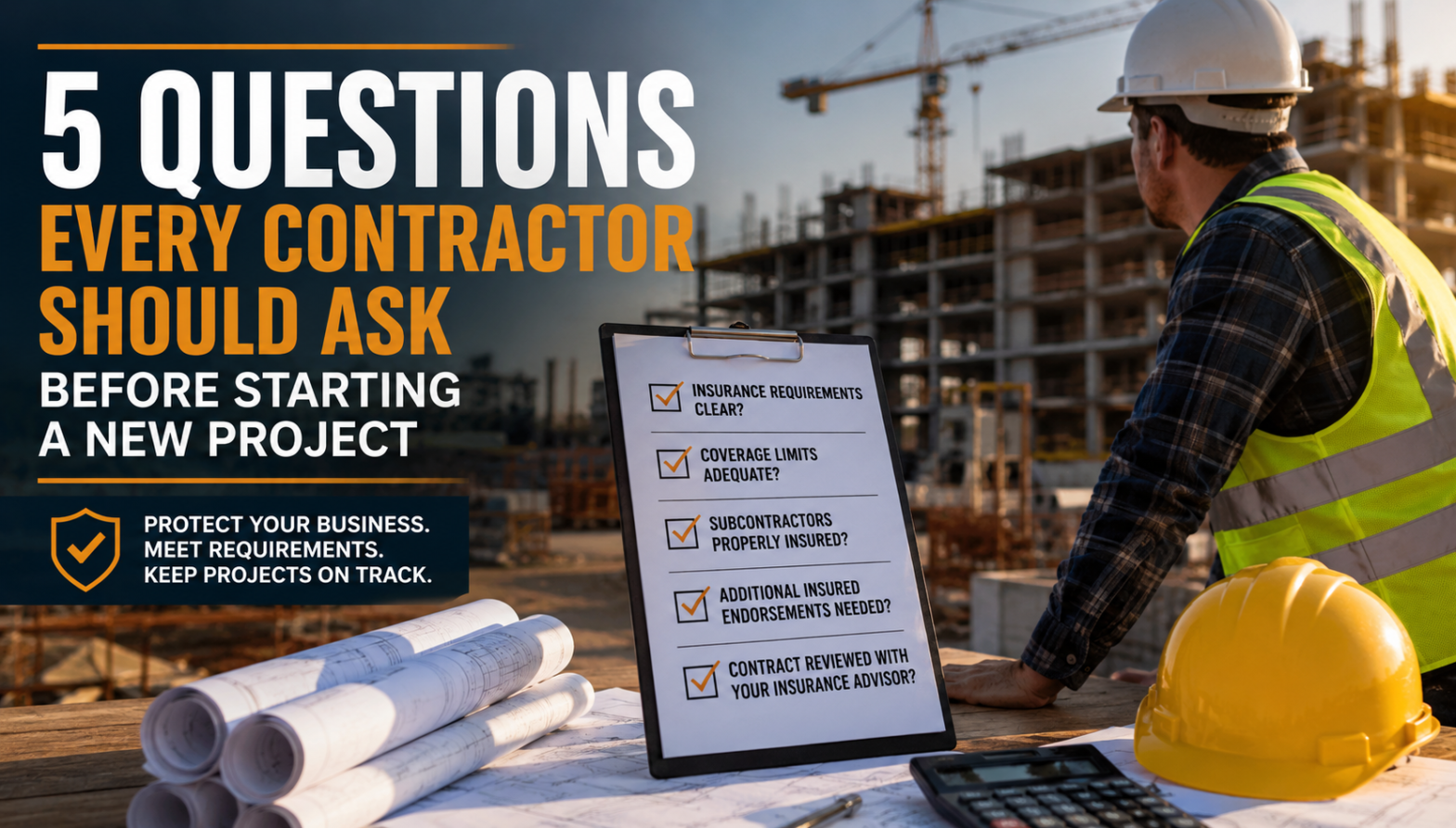
Before you start your next job, remember these five questions:
Each question helps you prepare for the work ahead instead of reacting to problems after construction has already started.
If you’re getting ready to bid a project or you’ve received a contract that includes insurance requirements, now is the time to review it.
The team at Integrated Commercial Insurance Solutions, Inc. works with contractors every day to explain contract requirements, identify possible coverage gaps, and help determine whether an insurance program meets the needs of a specific project.
Before you submit your next bid or begin work, send us your job requirements. We’ll review them with you, explain what they mean, and help you determine whether your current insurance meets the contract.
You can request a free insurance review or quote at https://icinssolutions.com/request-a-quote/ or call 800-922-9721. A short conversation today may help you avoid expensive surprises tomorrow.
Reviewing the insurance requirements before you submit your bid helps you understand what coverage the project requires. If additional policies or higher liability limits are needed, you can include those costs in your estimate instead of paying for them after you’ve won the job.
Not always. While General Liability is the foundation of many contractor insurance programs, some projects also require excess liability, pollution liability, professional liability, builders risk, inland marine coverage, or other specialized policies.
A certificate of insurance summarizes the coverage your policy already provides. An endorsement changes or adds to the policy itself. A certificate cannot create coverage or add endorsements that aren’t already included in your insurance policy.
Additional Insured endorsements help extend certain protections under your policy to the project owner or other parties named in the contract. Many commercial construction contracts require these endorsements before work can begin.
You should request updated certificates before each new project and monitor renewal dates throughout the project. Insurance policies can expire or change during the year, so relying on an old certificate may leave you with incomplete information.
At a minimum, verify that the subcontractor carries current General Liability, Workers’ Compensation, and any other insurance required for the work they perform. You should also maintain written subcontractor agreements and keep insurance documentation organized and up to date.
Yes. Every project owner can establish different insurance requirements depending on the size of the project, the type of work, and the risks involved. That’s why every contract should be reviewed individually.
It’s best to involve your insurance advisor before submitting your bid or signing the contract. Reviewing the insurance requirements early gives you time to identify coverage gaps, estimate insurance costs, and address any questions before construction begins.
This article is a collaboration between IC Insurance Solutions, Inc and OpenAI’s ChatGPT. Created on July 03, 2026, it combines AI-generated draft material with IC Insurance’s expert revision and oversight, ensuring accuracy and relevance while addressing any AI limitations.
Source: IRMI (International Risk Management Institute)
Construction contracts often contain detailed insurance and risk transfer provisions that affect contractors, owners, and subcontractors. This article explains common insurance requirements, contractual risk allocation, and why contractors should review insurance language before signing agreements.
URL: https://www.irmi.com/articles/expert-commentary
Source: Associated General Contractors of America (AGC)
This resource discusses practical ways contractors can reduce risk when hiring subcontractors, including documentation, communication, insurance verification, and contract management. It complements the article’s discussion of subcontractor oversight and project preparation.
URL: https://www.agc.org/
Source: National Institute of Building Sciences (NIBS)
The National Institute of Building Sciences provides guidance on identifying and managing construction risks throughout a project’s lifecycle. The material offers a broader perspective on planning, risk assessment, and project controls that support sound insurance and contract management practices.