Many contractors believe general liability insurance covers almost everything.
If something goes wrong on a jobsite, they expect the policy to step in and help.
A customer complains.
A subcontractor causes damage.
Tools get stolen.
A project owner asks for more coverage.
The contractor thinks:
“We have general liability. We’re covered.”
But that is not always true.
General liability insurance is one of the most important policies a contractor can carry. Still, many contractors do not fully understand what the policy covers — or what it leaves out.
That misunderstanding creates problems every day in construction.
Some contractors do not discover coverage gaps until:
By that point, the problem may already be expensive.
The issue is not that general liability insurance is bad.
The issue is assuming it covers every risk involved in running a construction business.
It does not.
Every contractor faces different exposures based on:
That is why understanding your policy matters.
Because the goal is not simply having insurance.
The goal is having coverage that matches the work you actually perform.
One of the most common things contractors say is:
“I already have liability insurance.”
Many times, they believe that means they are fully protected.
But general liability insurance is not “full coverage.”
It was created to help protect contractors from certain types of claims, mainly:
That protection matters. Construction work always carries risk. Even careful contractors can face accidents, claims, and unexpected situations.
But many contractors expect the policy to cover much more than it was designed to handle.
For example, some contractors believe general liability covers:
In many situations, it does not.
Part of the confusion comes from how contractors buy insurance today.
Many contractors are under pressure when purchasing coverage. They may need:
So the focus becomes:
“Get the policy started.”
Not:
“Let’s review what this policy actually covers.”
That creates problems later.
Every construction business is different. Every project creates different risks. Every project owner may require different coverage.
One general liability policy cannot automatically protect against every exposure a contractor faces.
Before talking about exclusions, it helps to understand what general liability insurance is designed to do.
At a basic level, general liability insurance helps protect contractors when their work causes injury or property damage to someone else.
For example:
A contractor is carrying materials through a customer’s home and accidentally damages a custom staircase.
Or a customer trips near a jobsite because debris was left in a walkway.
These are the types of situations general liability insurance is generally designed to help with.
The policy may help pay for:
That protection can help save contractors from major financial problems.
But many contractors hear the word “liability” and assume:
“Anything connected to my business is covered.”
That is where misunderstandings begin.
Insurance policies contain:
Those details become very important when something goes wrong.
This is one of the biggest misunderstandings contractors have about general liability insurance.
Many contractors believe:
“If my work fails, insurance will pay to fix it.”
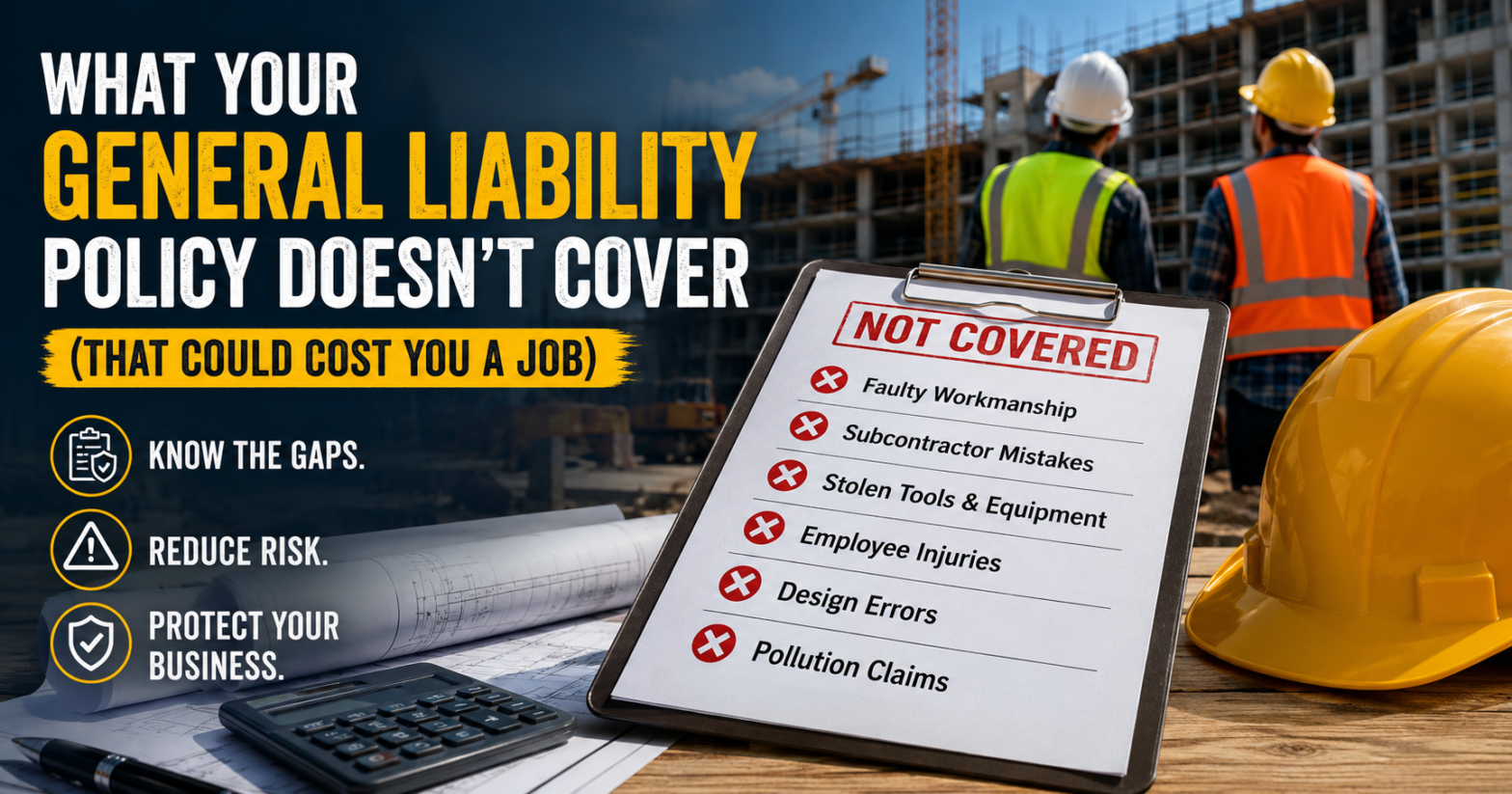
That is not always how the policy works.
For example:
A contractor installs windows during a remodel project. Several months later, water begins leaking around the windows because they were installed incorrectly.
Now there is damaged drywall, damaged framing, and an upset customer.
The contractor thinks:
“That’s why I carry insurance.”
But many general liability policies are not designed to pay for repairing the contractor’s own faulty work.
That surprises many contractors.
Another example:
A flooring contractor installs flooring incorrectly. Months later, the flooring buckles and separates.
The contractor expects the insurance company to pay for new flooring and labor costs.
But repairing the contractor’s own work may not fall under the policy.
This is one reason many contractors are surprised to learn what general liability does not cover until they are already dealing with a claim or contract issue.
General liability insurance is not a workmanship warranty.
On larger projects, repair costs can become very expensive very quickly.
Most general contractors use subcontractors. That is normal in construction.
The problem is that many contractors handle subcontractor insurance too casually.
A subcontractor says:
“Yeah, I have insurance.”
And the conversation ends there.
No updated certificate gets collected.
No subcontractor agreement gets signed.
No one checks workers compensation coverage.
No one tracks renewal dates.
Then later, something goes wrong.
A subcontractor damages property.
A subcontractor’s employee gets injured.
A claim appears months after the project is completed.
Now the general contractor discovers they may be responsible for the problem.
This happens far more often than many contractors realize.
Understanding proper subcontractor insurance requirements is one of the most important parts of protecting your business from downstream liability.
Contractors should always collect proof of:
But collecting a certificate once is not enough.
Insurance policies renew throughout the year. A subcontractor may have coverage in January and no coverage by August.
That is why contractors should track renewal dates carefully.
Contractors should also keep organized records for every subcontractor they hire.
That includes:
Without proper paperwork, it becomes much harder to separate the subcontractor’s responsibility from the general contractor’s responsibility.
Risk transfer means clearly separating who is responsible for what.
Without proper agreements and insurance structure, the general contractor may end up paying for problems caused by the subcontractor.
Many contractors do not discover weaknesses in their subcontractor process until a claim happens.
By then, the damage may already be done.
Another common misunderstanding involves tools and equipment.
Many contractors think:
“If my tools get stolen, my liability policy should cover them.”
Usually, it does not.
Imagine this situation:
A contractor leaves a trailer full of tools at a jobsite overnight.
The next morning, the trailer is gone.
Inside were:
Now the contractor must replace thousands of dollars in tools immediately.
The project may slow down. Cash flow may tighten. Crews may sit idle while replacement equipment is purchased.
General liability insurance is generally not designed to cover contractor-owned tools or equipment.
That is why many contractors carry Inland Marine coverage.
Despite the name, Inland Marine coverage often helps protect:
Without this type of coverage, contractors may be carrying a large uncovered risk without realizing it.
As contractors grow, many become more involved in:
That creates another exposure many contractors do not think about.
General liability policies usually do not cover professional advice or design mistakes.
For example:
A contractor recommends a drainage plan during a project. Months later, water damage develops because the drainage solution failed.
The contractor thinks:
“This happened during the project, so my policy should help.”
But claims involving advice, recommendations, or design-related work can fall outside standard general liability coverage.
This becomes more important on larger and more complicated projects.
The more a contractor becomes involved in planning and decision-making, the more important it becomes to understand where general liability protection ends.
When people hear the word “pollution,” many think about chemical plants or factories.
But pollution-related claims can happen on regular construction projects too.
For example:
These situations can create expensive claims.
Many contractors assume general liability insurance automatically covers them.
That assumption creates problems.
Some pollution-related claims require separate coverage.
Today, many larger projects require pollution-related coverage before contractors can begin work.
Again, the issue is not that contractors are careless.
The issue is that many contractors simply do not know where their policy stops protecting them.
Many contractors think insurance problems only appear after accidents.
That is not true.
Sometimes insurance issues cost contractors money before work even begins.
One of the biggest mistakes contractors make is bidding projects before reviewing the insurance requirements carefully.
This happens every day.
A contractor sees a good opportunity and submits a bid quickly.
They win the project.
Then they discover the contract requires:
Now the contractor must scramble to meet the requirements.
That can become expensive very quickly.
Many contractors do not realize how complex general contractor insurance requirements can become until they’ve already won the project.
For example:
A contractor wins a commercial remodel project expecting strong profit margins.
Then they discover the project owner requires $5 million in excess liability coverage.
The contractor only carries a standard $1 million policy.
Now they must purchase additional coverage just to begin work.
That extra cost cuts directly into profit.
In some situations, contractors realize the project is no longer worth taking after insurance costs are added.
This is why experienced contractors review insurance requirements before submitting bids.
Insurance affects profit more than many contractors realize.
Most contractors spend their days:
Reading insurance exclusions is usually not at the top of the list.
That makes sense.
But many contractors also never have someone explain:
So assumptions fill the gaps.
Assumptions in construction insurance can become expensive.
Two contractors may both carry general liability insurance but still have very different coverage depending on:
That is why policy reviews matter.
Not after a claim.
Before one happens.
General liability insurance is one of the most important policies a contractor can carry. It helps protect against serious claims involving injuries and property damage. But it does not cover every risk tied to running a construction business.
That is where many contractors get caught off guard.
A contractor may believe they are fully protected, only to discover later that:
These situations happen every day in construction.
The contractors who avoid major surprises are usually the ones who ask questions early, review their policies carefully, and understand where their coverage begins and ends.
Because the goal is not simply having insurance.
The goal is making sure your coverage matches the work you actually perform.
That becomes even more important as projects grow larger, subcontractors become involved, and job requirements become more demanding.
Many contractors are surprised to learn what general liability does not cover until they are already dealing with a claim or contract issue.
The good news is that many of these problems can be avoided before work even starts.
Reviewing your policies, understanding your exclusions, and checking project requirements ahead of time can help protect:
Many contractors do not realize how complex general contractor insurance requirements can become until they’ve already won the project.
Understanding proper subcontractor insurance requirements is also one of the most important parts of protecting your business from downstream liability.
If you are unsure what your current policy actually covers, now is the time to review it before the next problem appears.
Send your policy over and we’ll review it with you.
👉 https://icinssolutions.com/request-a-quote/
📞 Or call 800-922-9721
Integrated Commercial Insurance Solutions, Inc. helps contractors understand job requirements, identify coverage gaps, and avoid costly surprises before work begins.
Not always.
Many contractors believe general liability insurance will pay to repair their own faulty work, but that is often not how the policy works. General liability insurance is mainly designed to help with third-party bodily injury and property damage claims.
That is why many contractors are surprised to learn what general liability does not cover until they are already dealing with a problem.
General liability insurance may not automatically protect you from every subcontractor-related issue.
If subcontractors do not carry proper insurance, or if their paperwork is missing or outdated, the exposure can flow back to the general contractor.
That is why understanding proper subcontractor insurance requirements is so important.
Most subcontractors should carry:
The exact requirements depend on the project and contract.
General contractors should always collect updated certificates and track renewal dates.
Usually, it does not.
General liability insurance is generally not designed to cover contractor-owned tools, equipment, or materials.
Many contractors carry Inland Marine coverage to help protect:
If a subcontractor’s employee gets injured and there is no active workers compensation coverage, the exposure may come back onto the general contractor.
That can create:
This is one reason subcontractor verification matters so much.
Insurance requirements can affect project profit.
Some jobs require:
Many contractors do not realize how complex general contractor insurance requirements can become until they have already won the project.
Reviewing requirements before bidding helps contractors understand their real insurance costs ahead of time.
Usually, employee injuries fall under workers compensation insurance, not general liability insurance.
That is why contractors need both types of coverage.
Inland Marine coverage helps protect contractor tools, equipment, and materials.
It is commonly used for:
Not always.
Some pollution-related claims may require separate coverage.
Examples include:
Many larger projects now require pollution-related coverage before work can begin.
Many contractors purchase insurance quickly because they need:
But they may never fully review:
That is why many coverage problems are only discovered after a claim or contract issue appears.
Yes.
Two contractors may both carry general liability policies but still have very different protection depending on:
That is why policy reviews matter.
Review the insurance requirements before bidding the job.
Contractors should also:
Catching issues early can help avoid expensive surprises later.
This article is a collaboration between IC Insurance Solutions, Inc and OpenAI’s ChatGPT. Created on May 19, 2026, it combines AI-generated draft material with IC Insurance’s expert revision and oversight, ensuring accuracy and relevance while addressing any AI limitations.
Recommended Reading:
This article from Amwins explains several common exclusions found in Commercial General Liability (CGL) policies and how they apply to construction defect claims. It offers useful insight into why contractors often misunderstand what their policies actually cover during ongoing and completed operations.
Published by FASA, this article gives a practical breakdown of the “your work” exclusion and the subcontractor exception found in many CGL policies. It is especially valuable for contractors trying to understand how defective work claims and subcontractor-related damage may affect coverage.
URL: https://fasacares.org/the-your-work-exclusion-in-a-general-commercial-liability-policy/
This construction law practice note explains how gaps and exclusions in CGL policies can leave contractors exposed during claims. It also discusses risk transfer, subcontractor insurance verification, and common insurance pitfalls that contractors should address before starting a project.