You are reviewing a project and the insurance requirements ask for excess liability.
Maybe the job says $2M, $5M, or even higher limits are required. Now you need to know what that means, whether your current coverage meets the requirement, and how it may affect the job before you bid.
This guide explains excess liability insurance in plain English for contractors working in Texas and California.
Send Me Your Requirements—I’ll Review Them
Call or Text Rich
Key Takeaways
- Excess liability provides an additional layer of protection above underlying policies.
- Commercial and public projects often require higher liability limits.
- Contractors frequently discover excess liability requirements while reviewing bid documents or certificate requests.
- Texas and California projects can both require excess limits, but the wording and documentation may vary.
- Reviewing requirements before bidding helps prevent job-cost surprises.
- If the project requirements are in front of you, send them over and I’ll review them with you.
What Is Excess Liability Insurance?
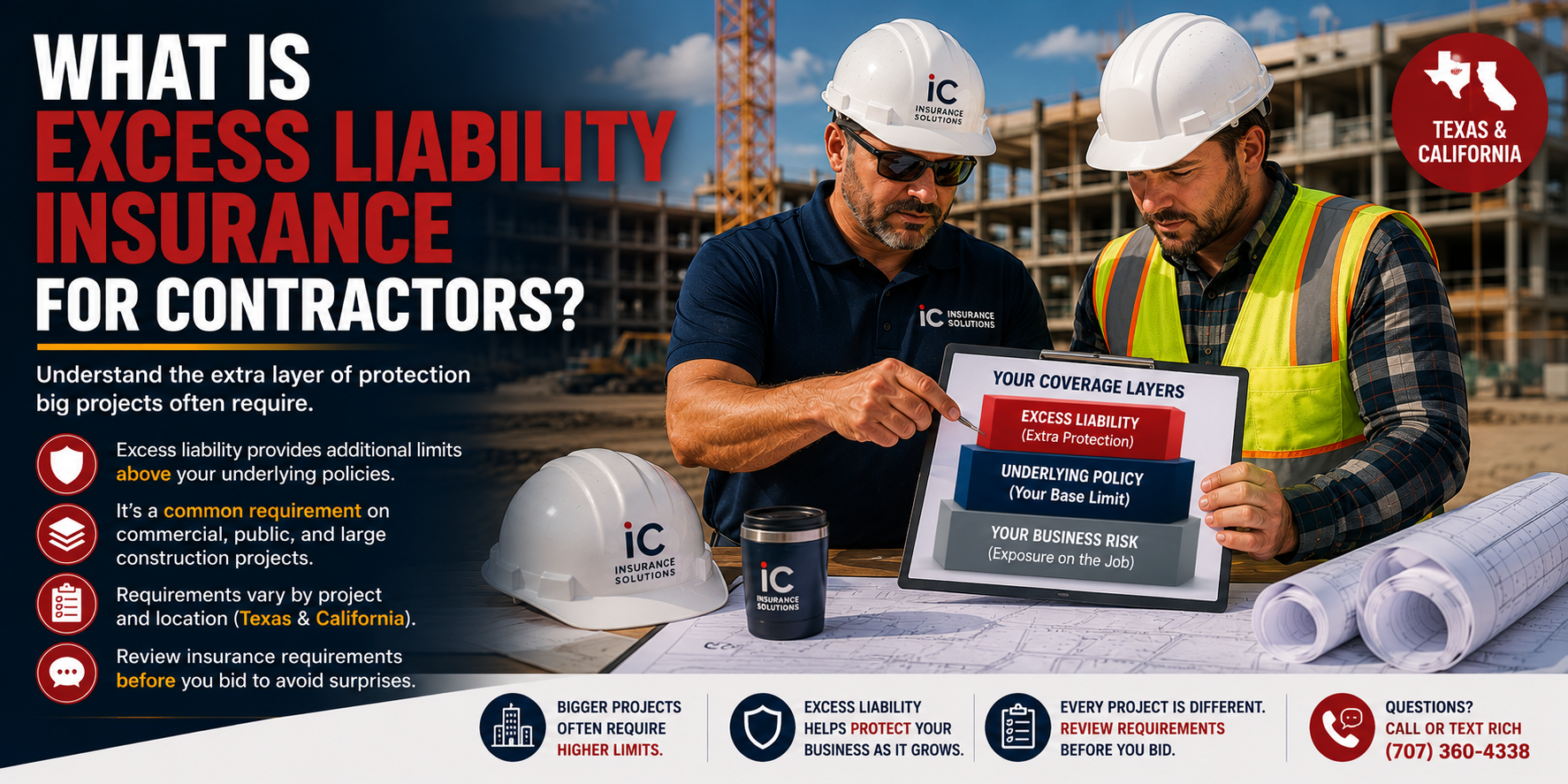
Excess liability insurance provides additional limits above an underlying policy when that underlying limit has been used up by a covered claim.
Think of it as another layer sitting above your base coverage. If a construction project requires more protection than your standard limits provide, excess liability may be the layer that helps meet that requirement.
Excess liability may sit above policies such as General Liability, Commercial Auto, or employer’s liability depending on the structure of the coverage and the job requirements.
Excess Liability vs. Umbrella Insurance
Contractors often hear “excess liability” and “umbrella insurance” used together. They are similar because both can provide additional limits, but the details matter.
Excess Liability
Excess liability generally follows the underlying coverage and adds more limit above it.
Umbrella Insurance
Umbrella insurance may provide broader protection depending on the policy language. The structure depends on the carrier, the underlying policies, and what the project is asking for.
Why Construction Projects Require Excess Liability
Owners, developers, municipalities, and general contractors often require excess liability because larger construction projects carry larger exposures.
You may see excess liability requirements on:
- Commercial construction projects
- Public works projects
- School or municipal projects
- Multi-family developments
- Industrial facilities
- Large retail or healthcare developments
When Contractors Usually Encounter This Requirement
Most contractors discover excess liability requirements when they are already looking at a real opportunity.
- Reviewing bid documents
- Receiving project insurance requirements
- Applying for subcontractor approval
- Bidding public works projects
- Responding to a certificate request
If you already have a requirement sheet, start with this pillar guide: Contractor Certificate Insurance Help.
How Excess Liability Affects Your Ability to Bid
Excess liability requirements can affect whether you qualify for the project, how the certificate needs to be prepared, and whether the job still makes sense after the insurance requirements are reviewed.
This is why contractors should review requirements before submitting the bid. The insurance burden can affect the real economics of the job. For more context, read How Much Insurance Will Cost Before You Bid.
Common Excess Liability Requirements Contractors See
Every project is different, but contractors commonly see requirements like:
- $1M to $2M excess liability on smaller commercial projects
- $2M to $5M excess liability on mid-sized commercial projects
- $5M to $10M or more on larger commercial, public, or institutional projects
- Additional wording such as additional insured, waiver of subrogation, and primary and non-contributory requirements
The limits are not the only thing that matters. The wording matters too.
Texas vs. California Excess Liability Requirements
Texas Projects
Texas projects can vary widely. Larger commercial, industrial, oil and gas, municipal, and infrastructure projects in Dallas, Houston, Austin, the Permian Basin, and other active markets often require higher limits.
California Projects
California projects often include more detailed insurance requirements and documentation expectations. Contractors working in Northern California, Sacramento-area markets, and larger commercial developments should review excess requirements carefully before bidding.
Common Contractor Mistakes
- Waiting until after winning the job to review insurance requirements
- Assuming current limits meet the project requirements
- Not reading the bid documents carefully
- Ignoring excess liability language
- Underestimating project insurance requirements
- Failing to review subcontractor obligations when subs are involved
To see how excess liability fits with other wording, review How to Read Construction Insurance Requirements Before You Bid.
Real Contractor Scenario
A contractor finds a project that looks like a strong opportunity. The requirement sheet asks for additional insured wording, waiver of subrogation, primary and non-contributory wording, and $5M in excess liability.
The contractor assumed the current coverage would satisfy the job. But once the requirements are reviewed, it becomes clear that the project carries additional insurance obligations that should have been considered before pricing the job.
Excess Liability Checklist Before You Bid
- Review project insurance requirements.
- Identify required liability limits.
- Review excess or umbrella requirements.
- Check additional insured requirements.
- Review waiver of subrogation requirements.
- Look for primary and non-contributory wording.
- Compare requirements against your current coverage setup.
- Ask questions before submitting the bid.
How I.C. Insurance Solutions Helps Contractors
We help contractors review project insurance requirements before they bid, request certificates, or commit to work. The goal is to explain what the project is really asking for in plain language.
- Review project insurance requirements
- Explain coverage requirements clearly
- Help contractors evaluate project eligibility
- Identify potential issues before bidding
- Available by phone and text
Helpful Related Resources
Frequently Asked Questions
What is excess liability insurance for contractors?
Excess liability insurance provides additional limits above an underlying policy after that underlying limit has been used up by a covered claim.
Is excess liability the same as umbrella insurance?
They are similar, but not always identical. Excess liability usually adds limits above an underlying policy, while umbrella coverage may provide broader protection depending on the policy language.
Why do construction projects require excess liability?
Larger projects often carry larger exposures, so owners, developers, municipalities, and general contractors may require higher liability limits.
How much excess liability do contractors need?
It depends on the project requirements. Some projects require $1M or $2M, while larger commercial or public projects may require $5M, $10M, or more.
Should contractors review excess liability requirements before bidding?
Yes. Reviewing excess liability requirements before bidding helps contractors understand project obligations, qualification issues, and potential job-cost impact.