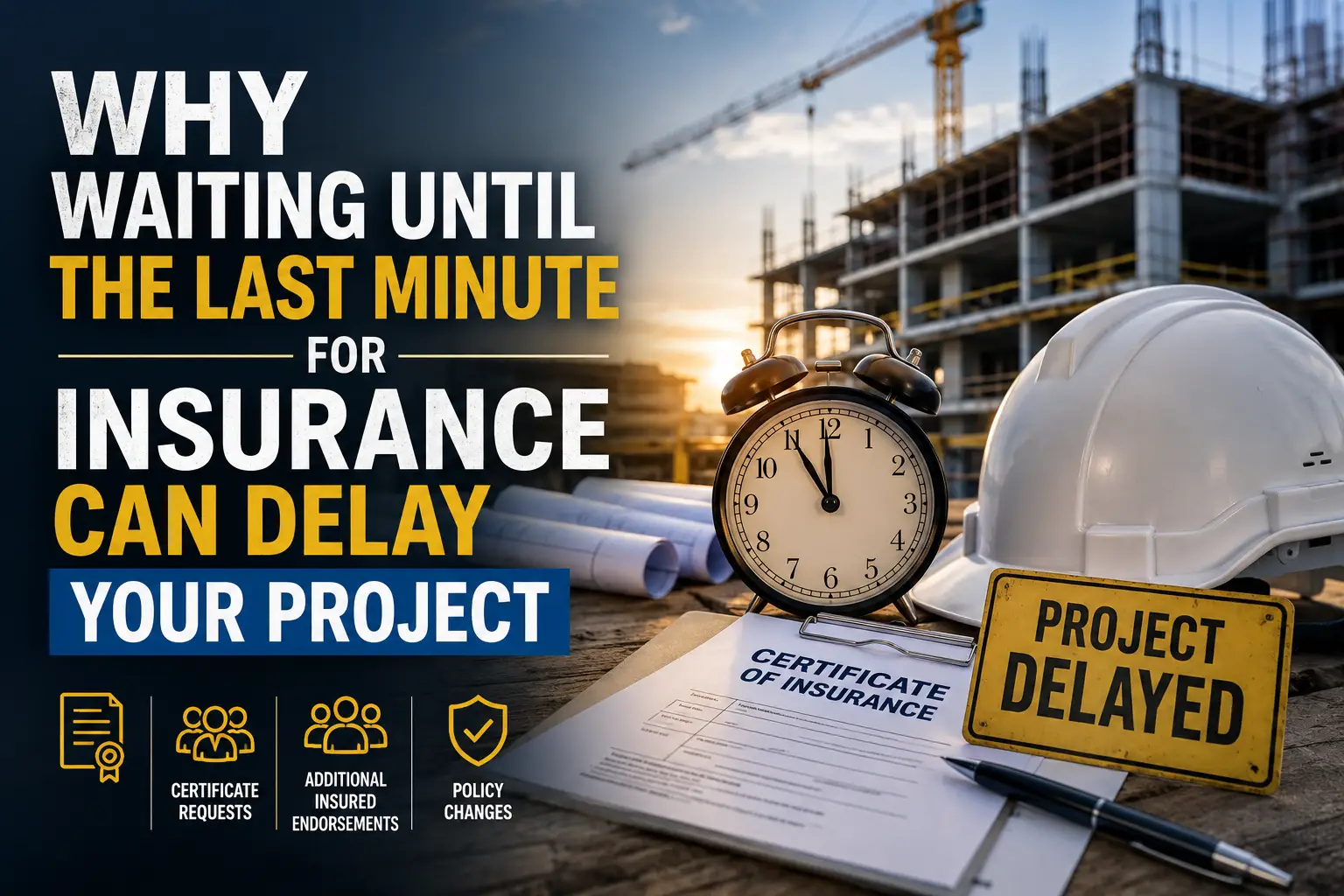
You won the job. Your crew is ready. Materials are on the way. Your subcontractors know when to show up. The project is set to start Monday morning.
Then you get an email Friday afternoon.
The project owner needs a certificate of insurance before your crew can start. The contract also includes a list of insurance requirements. It calls for certain limits, additional insured status, and other insurance terms.
You already have insurance, so you may think this will be easy. You send the request to your insurance broker and expect a certificate back.
Then you find out the project requires something your current policy does not provide.
Maybe the contract requires higher liability limits. Maybe it calls for an additional insured endorsement that needs to be reviewed. It could require excess liability, pollution liability, professional liability, or another type of coverage you do not have.
Now you have more than a certificate request.
You have an insurance issue to solve, and your crew is supposed to start in a few days.
This is why it pays to review insurance requirements early. If your current policies already meet the job requirements, providing the needed documents may be simple. If they do not, you may need a policy change, an endorsement, higher limits, or another type of insurance.
Finding that out early gives you more time to handle the issue without putting the project schedule at risk.
Contractors usually do not think about insurance unless there is a reason. You are focused on the job.
How many workers will you need? Which subcontractors are available? What materials need to be ordered? When can you start? How long will the work take? Will the job produce the profit you expect?
Insurance becomes part of that planning when the contract says you must meet certain requirements before you can work.
A project owner or general contractor may require proof of insurance before allowing your crew onto the site. The contract may set minimum general liability limits. It may require workers’ compensation or commercial auto coverage. It may also call for additional insured status, excess liability, or other coverage based on the work being performed.
Those requirements can change from one project to another.
Problems often happen when contractors review them too late.
A contractor bids the job. The bid is accepted. A start date is set. Crews and subcontractors are scheduled. Then someone asks for the certificate.
At that point, everyone expects the insurance to be ready.
Sometimes it is. Other times, this is the first time anyone compares the contractor’s policies with the contract requirements.
That is when the contractor may find a problem.
A better plan is to review the construction job insurance requirements before you commit to the project whenever possible.
You want to know what the job requires while you still have time to address it.
A contractor may call an insurance broker and say, “I just need a certificate so I can start this job.”
That request makes sense. Someone is asking for the certificate, and the contractor needs it to get to work.
But the certificate is only one part of the issue.
A certificate of insurance provides information about insurance that is already in place. It does not add coverage to your policy.
For example, suppose your general liability policy has a $1 million limit.
You win a new project, but the contract requires a higher limit.
You cannot solve that problem by asking your broker to put the higher limit on the certificate. The insurance policy must support the amount shown on the certificate.
The same rule applies to other requirements.
If the contract requires an endorsement, putting words on a certificate does not mean the policy now has that endorsement.
If the contract requires excess liability and you do not carry it, the certificate cannot create that coverage.
This creates a clear difference between two situations:
“We have the required insurance and need to provide proof.”
And:
“The job requires insurance we do not currently have.”
The first situation may only require the right documents. The second may require changes to your insurance.
If you find out about the second problem two weeks before the job starts, you have time to work on it.
If you find out Friday afternoon and your crew starts Monday, the same problem can become urgent.
If you have an immediate certificate request, you can learn more about contractor certificate of insurance help. When possible, send the full insurance requirements with your certificate request. That gives your insurance professional a chance to see what the job is asking for rather than looking at the certificate request alone.
Additional insured requirements are common in construction contracts.
A project owner or GC may require a contractor to provide additional insured status to certain companies or people involved with the project.
The request may sound simple:
“Add our company as an additional insured and send the certificate.”
A contractor may think this means the insurance broker only needs to type another name onto the certificate.
But that is not how the coverage works.
The policy and its endorsements control the actual insurance. A certificate by itself does not create additional insured coverage.
Suppose a contractor gets a new project from a large GC. The contractor has provided certificates many times before and does not expect a problem.
A few days before the project starts, the GC sends over its insurance requirements. Several parties need additional insured status. The contract also calls for specific insurance terms.
The contractor forwards the names to the broker and asks for a new certificate.
The broker now needs to compare the request with the contractor’s policy.
Who needs additional insured status? Which policy does the requirement apply to? Does the current policy have an endorsement that addresses the request? Is a certain endorsement required? Does the contract include requirements related to completed operations?
These questions do not mean the contractor has done something wrong. They simply need answers before the broker can determine how the existing insurance lines up with the contract.
Timing makes a big difference.
If the contractor sends the requirements over well before the job starts, there is time to review them.
If the requirements arrive when the crew is already waiting to work, every unanswered question becomes more urgent.
That is the problem with waiting until the last minute.
Not every insurance requirement can be handled by issuing another certificate.
Sometimes a job requires more insurance than a contractor normally carries.
Suppose your company has an insurance program that works for the projects you usually perform. You carry general liability, workers’ compensation, commercial auto, and other coverage that fits your normal operations.
Then a larger project comes along.
You prepare your bid. You figure labor, materials, subcontractors, equipment, overhead, and expected profit.
You win the job.
After the contract is signed, someone reviews the insurance section and sees that the owner requires several million dollars in excess liability.
You do not currently carry that amount.
This is not a problem that can be fixed by changing the certificate. You need to find out what insurance may be needed to meet the requirement.
The same type of issue can happen with pollution liability or professional liability.
You may not need these policies for every project you perform, but a certain contract may still require them.
Finding out before you bid gives you time to ask questions.
Does the requirement apply to your work? What would be needed to meet it? Does your current insurance already address part of the requirement? Will you need another policy or a change to an existing one?
There may also be times when you want to discuss a requirement with the client.
For example, a contract may ask for insurance that does not seem to fit your scope of work. The client may agree to change the requirement, or the client may decide to keep it.
That conversation is easier to have before you sign the contract.
Once you have agreed to the job, you may have fewer choices.
Reviewing the requirements before bidding is not just an insurance task. It is part of understanding what it will take to perform the job.
Insurance can also affect the numbers behind a project.
Contractors put a lot of work into a bid.
You calculate labor and material costs. You get numbers from subcontractors. You figure equipment needs and overhead. Then you decide how much you need to charge for the job to make the expected profit.
Now imagine that you win the project and later find out it requires insurance you did not include in those numbers.
You may still be able to get the required coverage. But meeting that requirement is now part of the cost of performing the work.
The problem is that you did not know about it when you prepared the bid.
This is one reason Rich Tygett recommends sending job insurance requirements to your broker before bidding whenever possible.
Knowing what the job requires gives you a better chance to understand the insurance burden before you commit.
This can matter even more as your company takes on larger projects.
A contractor may work for years with clients that have similar insurance requirements. Then a new owner or GC sends over a contract with much higher limits or several coverage requirements the contractor has never dealt with before.
That does not automatically make the project a bad opportunity.
It means you should find out what those requirements mean before you agree to them.
The project may still be a good fit for your company. But you should make that decision with a clear idea of what the job will require.
A construction schedule depends on many people doing their work at the right time.
Suppose your project starts Monday.
Your superintendent has scheduled the crew. A subcontractor is coming Wednesday. Equipment has been set aside for the job. Materials are arriving. Another trade plans to start after your portion of the work is complete.
Then the project owner says your insurance documents have not been approved.
If approval is required before work begins, the problem can quickly move beyond insurance.
Your crew may need to wait. A subcontractor’s schedule may need to change. Equipment may sit unused or need to go to another project. Deliveries may need to be moved. Other work on the project could also be affected.
Not every certificate problem will stop a project.
Still, if insurance approval is required before you can start, it should be treated as part of pre-job planning.
Contractors already plan around permits, materials, workers, equipment, and subcontractors. Insurance requirements deserve attention at the same stage when they are part of the contract.
A rejected certificate can be frustrating.
You thought you sent what the project asked for. Now someone is telling you it is not acceptable.
Instead of guessing what needs to change, ask why the certificate was rejected.
The answer may point to a simple document issue. Or it may show that the project requires something different from what your policy provides.
For example, the owner or GC may be looking for a higher limit. They may be asking for proof of additional insured status or a certain endorsement.
Start with the insurance requirements and see what the contract says.
Then compare that requirement with your actual insurance.
This can help separate a paperwork issue from a policy issue.
If the certificate needs to show information that is already supported by the policy, that is one type of problem.
If the contract requires coverage or an endorsement that is not part of the current policy, that is another.
Finding the reason for the rejection helps everyone focus on the right issue.
Timing matters here, too.
A rejected certificate ten days before the project starts gives you more room to work through the issue.
A rejected certificate on the morning your crew is scheduled to arrive can create a much harder situation.
One of the best ways to prevent last-minute problems is to move the insurance review earlier in your project process.
When a client sends you a contract or insurance exhibit, send it to your insurance professional.
Do not assume that because you have general liability insurance for contractors you meet every requirement in the contract.
General liability is an important coverage for contractors, but it does not cover every risk. Policies also contain exclusions, conditions, and endorsements that can affect how coverage applies.
Your insurance professional can compare the job requirements with the policies you carry.
The goal is to find out what already matches and what may need attention.
If the job requires higher limits, you want to know before bidding.
If it requires excess liability, you want to know early.
If the owner wants additional insured endorsements, identify that before the start date.
If the contract calls for pollution liability or professional liability, find out what the requirement means for the work you are doing.
You do not need to understand every line of insurance language yourself.
Send the requirements and ask questions.
When you ask your insurance professional to review a project, send the complete insurance requirements when you can.
The full requirements are more useful than a short email saying, “I need a certificate.”
It also helps to send the project name and location, required limits, additional insured information, requested endorsements, and any instructions from the owner or GC.
Make sure your insurance professional knows the deadline.
The project start date is not always the insurance deadline.
For example, your crew may start Monday, but the GC may require all insurance documents to be approved by Thursday.
In that case, Thursday is the date you need to plan around.
Knowing the approval date gives everyone more time to handle questions before the project is waiting on insurance.
There is no single timeline that works for every contractor and every project.
Some certificate requests are simple because the contractor already has insurance that meets the requirements.
Other jobs may require a policy change, different limits, another endorsement, or a type of coverage the contractor does not carry.
Those requests can involve more steps.
An insurer or underwriter may need more information before approving a change. Questions may need to be answered. A new type of coverage may need to be reviewed.
Your project schedule does not control how long each of those steps will take.
The safest approach is simple: send the requirements as soon as you receive them.
If everything already lines up, you can move forward knowing the insurance requirements have been reviewed.
If something needs attention, you have more time to work on it.
Either outcome is better than finding out when the crew is ready to start.
The worst time to find an insurance problem is when your crew is ready to work.
If your current policies already meet the project’s requirements, getting the needed insurance documents may be fairly simple.
But a certificate request can also show that something is missing.
The job may require a higher limit. The contract may call for additional insured status or a certain endorsement. It may require excess liability or another coverage you do not currently carry.
Those are insurance issues, not just certificate issues.
The best time to find them is before you bid or start the job.
Get the insurance requirements from the owner or GC. Send them to your insurance professional. Find out what the contract requires and compare those requirements with the insurance you already have.
If something needs to change, you will have more time to address it.
If your current insurance already meets the requirements, you can move ahead knowing the job’s insurance needs have been reviewed.
Most of all, do not assume that having a certificate means every contract requirement has been met. The policy behind the certificate is what provides the coverage.
If you have an upcoming project and need contractor insurance, request a quote from Integrated Commercial Insurance Solutions, Inc. or call us at 800-922-9721.
If you already have the project’s insurance requirements, have them ready when you contact us. We can review what the job is asking for and help you determine what insurance may be needed before your scheduled start date arrives.
A project may require approved insurance documents before your crew can begin work. If a last-minute certificate request shows that your current policy does not meet the contract requirements, you may need an endorsement, higher limits, a policy change, or another type of coverage. Those issues may take more time than issuing a certificate.
No. A certificate of insurance provides information about insurance that is already in place. It does not add coverage, increase policy limits, or create an endorsement that is not part of the underlying policy.
No. The limits shown on the certificate should reflect the insurance that is actually in place. If a project requires higher limits than you currently carry, you need to discuss the requirement with your insurance professional.
Not by itself. Additional insured coverage depends on the policy and the endorsements that apply. The contract requirement should be compared with the actual policy to determine how the request can be addressed.
Project owners and general contractors may require additional insured status as part of their risk-transfer requirements. The exact wording and scope can vary from one contract to another, so the requirement should be reviewed rather than assumed.
Ask the requesting party why it was rejected and get the exact requirement they believe is missing. Then compare that requirement with your policy and endorsements. This can help determine whether the issue involves the certificate itself or the insurance behind it.
Talk with your insurance professional as early as possible. Depending on the requirement, you may need another type of coverage, different limits, or a change to an existing policy. It is better to identify that before you bid or sign the contract.
Yes. If a project requires higher limits or another type of insurance, meeting those requirements may affect the cost of performing the job. Reviewing the insurance section before bidding gives you a chance to account for that burden.
As soon as you receive them. Ideally, the requirements should be reviewed while you are still evaluating the job rather than after the contract has been signed and the start date has been set.
Send the full insurance requirements when possible, along with the project name, location, required limits, additional insured information, requested endorsements, approval deadline, and any comments explaining why a previous certificate was rejected.
This article is a collaboration between IC Insurance Solutions, Inc and OpenAI’s ChatGPT. Created on Aug 11, 2026, it combines AI-generated draft material with IC Insurance’s expert revision and oversight, ensuring accuracy and relevance while addressing any AI limitations.