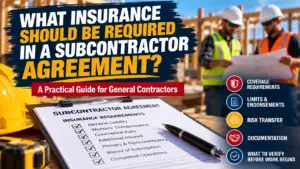
You have the plans, the scope, and the job requirements in front of you. Now the insurance wording shows up.
Most contractors skim that section, assume it is standard, and keep moving. But that wording can affect your cost, your exposure, your subcontractor responsibilities, and whether the job still makes sense before you bid.
This guide explains what to look for in plain language, especially for contractors working in Texas and California.
Send Me Your Requirements—I’ll Review Them
Call or Text Rich
Key Takeaways
- Construction insurance requirements are often more important than the certificate itself.
- Contract wording can affect cost, exposure, and job profitability.
- Additional insured, waiver of subrogation, primary and non-contributory wording, and excess liability all matter.
- California projects often carry stricter wording than Texas projects, but both should be reviewed carefully.
- Most contractor insurance problems start with requirements that were never fully reviewed.
- Before you bid, send me your requirements—I’ll review them.
Why Insurance Requirements Catch Contractors Off Guard
Insurance requirements usually arrive after you are already focused on labor, materials, schedule, and margin. They feel technical, so they are easy to skim.
The problem is that this section can define what coverage you must carry, what wording must be added, what limits are required, and what responsibilities you may be taking on before the work even starts.
What You’re Really Looking At
Construction insurance requirements may appear in a few different places:
- Insurance exhibit
- Contract insurance section
- Owner requirements
- General contractor requirements
- Bid packet or project onboarding documents
If the project is asking for a certificate, start with this pillar guide: Contractor Certificate Insurance Help.
The Insurance Terms That Matter Most
Additional Insured
This usually means the project owner, general contractor, or another party wants to be included under your coverage for certain liability tied to your work. It is one of the most common requirements contractors see.
Waiver of Subrogation
In plain English, this can limit your insurance company’s ability to recover from another party after a claim. Owners and GCs often request it because they want fewer disputes after a loss.
Primary and Non-Contributory
This wording usually means your coverage should respond first and not seek contribution from another party’s insurance. That can matter a lot when the job involves multiple contractors and layered responsibility.
Excess Liability
Excess liability adds another layer above underlying policies such as general liability, commercial auto, or workers’ comp employer’s liability. This can materially affect the job cost if it was not planned before bidding.
Texas vs. California Construction Insurance Requirements
Texas projects can vary widely. Some requirements are straightforward, while larger projects in Dallas, Houston, Austin, the Permian Basin, or other growing markets may still ask for higher limits and stronger wording.
California projects often involve more formal contract structures, more detailed insurance wording, and stricter expectations around risk transfer. Northern California contractors especially should review requirements before bidding, because small wording differences can affect the whole job.
Warning Signs Inside Insurance Requirements
- High excess liability limits
- Wording that exceeds your current coverage setup
- Subcontractor obligations you have not accounted for
- Waiver requirements buried in multiple parts of the contract
- Requirements copied from a larger commercial project that may not fit your role
- Any wording you cannot clearly explain back to yourself
If something looks unclear, send it over for review.
Why Requirements Directly Affect Profitability
A contractor may win the job and only later realize the requirements ask for coverage that was never included in the bid. That is where margin can disappear.
Higher limits, excess liability, subcontractor requirements, and special wording can all affect what the job really demands. Reviewing requirements early helps you understand the insurance burden before you commit.
Pre-Bid Insurance Checklist
- Review the insurance exhibit or contract insurance section.
- Identify required general liability limits.
- Look for additional insured, waiver, and primary/non-contributory wording.
- Check for excess liability requirements.
- Review subcontractor obligations.
- Compare the requirements to your current coverage.
- Ask questions before submitting the bid.
Helpful Related Resources
Frequently Asked Questions
They are the contract or project rules that explain what coverage, limits, wording, and proof of insurance a contractor must provide before or during a job.
What does additional insured mean?
It usually means another party, such as the owner or general contractor, wants to be included under your coverage for certain liability related to your work.
What is waiver of subrogation?
It is wording that can limit your insurance company’s ability to recover from another party after a claim. It is common in construction contracts.
What does primary and non-contributory mean?
It generally means your coverage is expected to respond first and not share the loss with another party’s insurance.
Should contractors review insurance requirements before bidding?
Yes. Reviewing requirements before bidding helps contractors understand the real insurance burden, avoid surprises, and protect job profitability.