Every contractor has been there.
You spend days reviewing plans, calling suppliers, checking material prices, talking with subcontractors, and double-checking your numbers. After all that work, you submit your bid and wait.
Then the phone rings.
“You got the job.”
For a few minutes, everything feels great. Your hard work paid off, and you’re ready to get started.
Then the contract arrives.
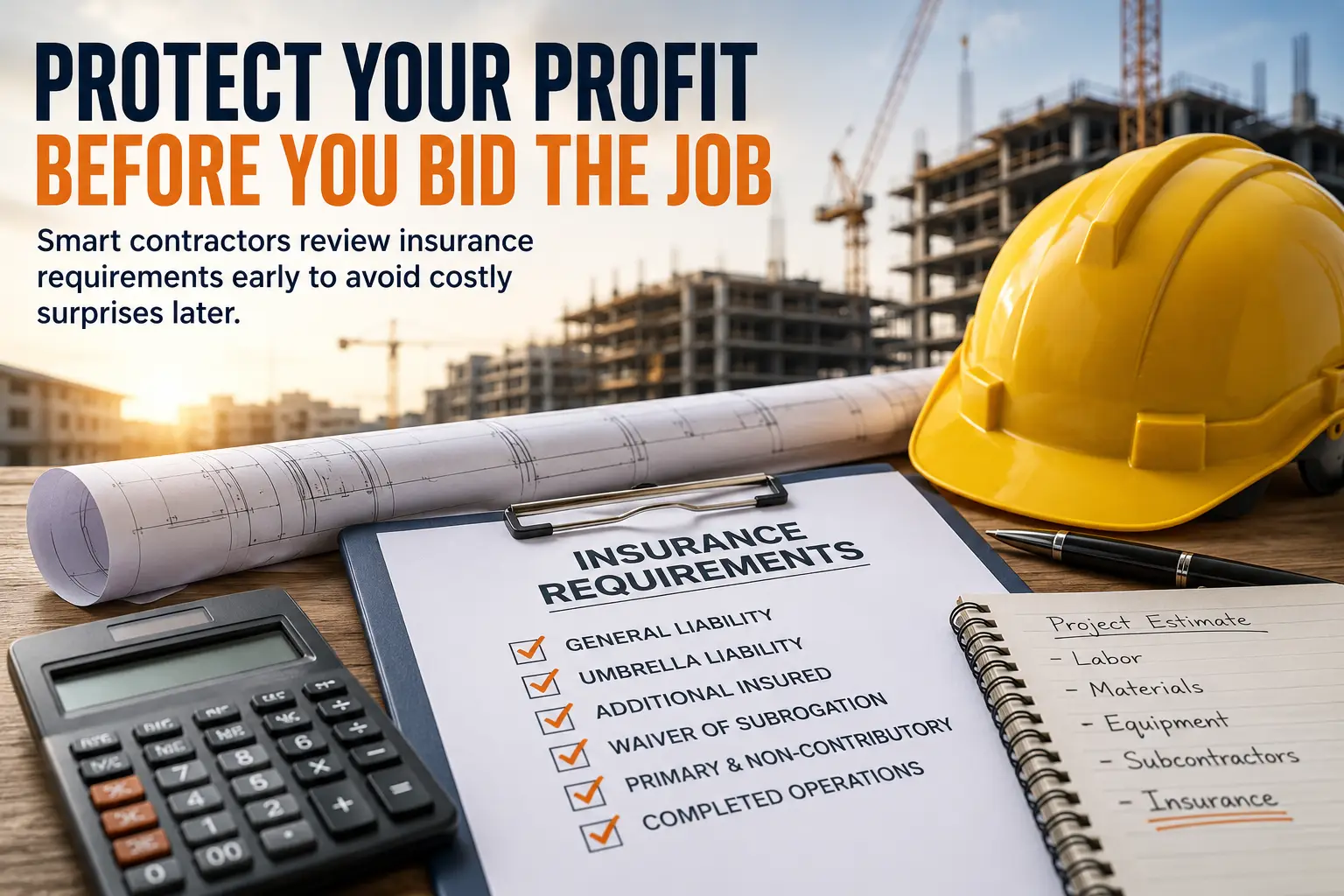
As you read through the paperwork, you notice several pages explaining the owner’s insurance requirements. The project calls for higher liability limits than you currently carry. It also requires additional insured status, waiver of subrogation, primary and non-contributory wording, and several other endorsements.
None of those costs were included in your estimate.
Now you have a choice. You can pay for the additional coverage and accept less profit than you planned, or you can try to work through the issue after you’ve already accepted the job. Neither option puts you in a good position.
This happens more often than many contractors realize.
The problem usually isn’t poor estimating. It’s reviewing the insurance requirements too late.
Contractors spend a lot of time estimating labor, materials, equipment, and subcontractor costs because they know those expenses determine whether a project will make money. Insurance deserves that same attention.
The contractors who consistently protect their profits don’t wait until they’ve won the job to think about insurance. They review the contract while they’re still preparing their bid. That gives them time to understand the owner’s requirements, determine whether their current coverage meets those requirements, and include any additional insurance costs in their estimate if necessary.
A little planning before you submit your proposal can save a great deal of frustration after the project has been awarded.
No two construction projects are exactly alike.
You may complete two office remodels in the same city, yet the insurance requirements can be completely different. One owner may accept your existing coverage without any changes. Another may require higher liability limits, additional endorsements, or specialized policies before work can begin.
Many contractors assume that because they already have insurance, every project will be covered the same way.
That isn’t always the case.
Property owners, developers, municipalities, school districts, hospitals, and large general contractors often create their own insurance standards. Those standards are based on the size of the project, the type of work being performed, and the amount of risk they believe the project involves.
Those requirements aren’t just legal language buried in the contract.
They often have a direct effect on what the project will cost you.
Think about how you estimate concrete for a foundation.
You don’t guess how much you’ll need. You measure the area, calculate the volume, and include that cost in your estimate before you submit your bid.
Insurance should be treated the same way.
If additional coverage is required, you want to know about it before you’ve promised to complete the work for a certain price.
That’s one reason experienced contractors review every contract carefully instead of assuming the insurance requirements will be the same as the last project.
Most contractors spend hours studying plans and specifications before they prepare an estimate.
That’s time well spent.
Those documents tell you what you’re building, what materials you’ll need, and how the work should be completed.
The contract deserves the same attention.
Many contractors skim through the insurance section because it looks like standard legal language. Sometimes that’s all it is.
Other times, those pages contain requirements that can affect your profit.
The owner may require higher liability limits than your current policy provides.
The contract may require endorsements that aren’t included with every insurance policy.
Some projects call for additional coverage because of the type of work being performed or the location of the project.
If you don’t notice those requirements until after you’ve won the job, you may have to pay for insurance that wasn’t included in your original estimate.
That extra cost comes directly out of your profit.
Before you submit your proposal, take time to review the construction job insurance requirements listed in the contract. If something isn’t clear, ask questions before you bid.
You may find that your current insurance already satisfies every requirement.
You may also discover that you’ll need additional coverage or endorsements.
Either way, you’ll know the full cost of the project before you commit to it.
That’s a much better position than trying to solve insurance issues after the contract has been signed.
One of the biggest misunderstandings in construction involves certificates of insurance.
Some contractors believe that once a certificate is issued, every insurance requirement in the contract has been satisfied.
A certificate doesn’t work that way.
It simply shows the coverage you already have.
It doesn’t increase your liability limits.
It doesn’t add endorsements.
It doesn’t create coverage that isn’t already included in your policy.
For example, suppose a project owner requires additional insured status, but your current policy doesn’t include that endorsement.
Your insurance agent can’t solve the problem by typing different wording onto the certificate.
The policy itself has to provide that coverage.
The same is true for higher liability limits or other contract requirements.
That’s why reviewing insurance requirements before bidding is so valuable.
You have time to compare your current coverage with the owner’s requirements while you’re still preparing your estimate.
If changes are needed, you can learn what they will cost before you submit your bid instead of after you’ve accepted the project.
General Liability insurance is one of the most important policies a contractor can carry.
It helps protect your business against many claims involving bodily injury or property damage to other people. Without it, one accident could have a serious financial impact on your company.
At the same time, General Liability wasn’t designed to cover every situation a contractor might face.
Each project brings its own challenges.
A large commercial project may require higher liability limits than your current policy provides.
Another project may involve environmental concerns that call for pollution liability coverage.
If your company provides design recommendations or consulting services, professional liability coverage may also need to be considered.
The point isn’t that every contractor needs every type of insurance.
The point is that every project deserves its own review.
Learning more about contractor general liability insurance can help you understand what your policy is designed to cover and where additional protection may be needed.
You don’t have to become an insurance expert before submitting a bid.
You simply need to know whether the coverage you already carry matches the requirements of the project you’re bidding.
That knowledge can help you prepare a more accurate estimate, avoid unexpected costs, and protect the profit you’ve worked hard to earn.
When you’re focused on winning a project, it’s easy to overlook details that seem minor.
An endorsement here.
A higher liability limit there.
A request for additional coverage that you’ve never needed before.
On paper, those items may not look like much.
In practice, they can change the cost of the job.
Imagine you’re bidding a medical office renovation.
You’ve priced the materials, confirmed labor costs, and received quotes from your subcontractors. After reviewing everything, you’re confident in your estimate and submit your proposal.
A week later, you learn you’ve won the project.
Then the owner sends the final insurance requirements.
The contract requires a $5 million umbrella policy, several policy endorsements, and additional completed operations coverage that you don’t currently carry.
Your insurance company can provide the coverage, but it comes with an additional premium.
Because those costs weren’t included in your estimate, your expected profit immediately becomes smaller.
Nothing about the construction work changed.
The insurance requirements did.
Finding that out before you submit your bid gives you the chance to include those costs in your proposal instead of paying them yourself later.
That’s one of the simplest ways to protect the profit you’ve built into every project.
As your business grows, the jobs you take on usually grow too.
You may move from small remodeling jobs to schools, office buildings, warehouses, shopping centers, or apartment complexes. These projects often offer better opportunities, but they also come with more responsibility.
Project owners have more at stake on larger jobs. If something goes wrong, the financial loss can be much greater. That’s one reason many owners require contractors to carry higher insurance limits or additional types of coverage.
That doesn’t mean larger projects should be avoided.
It simply means you need to understand the full cost of the job before deciding what to bid.
Think about a contractor bidding two different projects.
The first is a small office renovation that only requires the contractor’s existing insurance. The second is a new medical building that requires higher liability limits, additional insured endorsements, completed operations coverage, and an umbrella policy.
The construction work may not be dramatically different, but the insurance requirements certainly are.
If both projects are priced the same way, one estimate is likely to be wrong.
That’s why reviewing the insurance requirements before you prepare your final numbers is so important. When you know what coverage the owner expects, you can build those costs into your estimate instead of paying for them after the contract has been awarded.
A profitable project begins with an accurate estimate, and that estimate should include every major cost of doing the work.
Most general contractors depend on subcontractors.
Electricians, plumbers, roofers, painters, concrete contractors, HVAC companies, and many other trades help keep projects moving. Building relationships with dependable subcontractors allows your business to take on larger jobs and complete them more efficiently.
Working with subcontractors also means paying attention to their insurance.
It’s easy to assume that once you’ve collected a certificate of insurance, everything is taken care of.
That’s only the first step.
Insurance policies expire.
Coverage limits change.
Businesses switch insurance companies.
Sometimes a policy is canceled because premiums weren’t paid.
If one of your subcontractors no longer has the coverage required by your contract, that problem can quickly become your problem.
Imagine you’re halfway through a commercial project when a subcontractor’s employee is injured. During the review, you learn the subcontractor’s Workers’ Compensation policy expired several weeks earlier.
Now questions begin.
Who is responsible?
Will work stop while the issue is sorted out?
Will your customer lose confidence in your company?
Situations like this are much easier to prevent than they are to fix.
Good contractors create a simple process for reviewing subcontractor insurance before work begins and checking that coverage remains current throughout the project.
Learning more about subcontractor insurance can help you build that process. It’s a practical way to reduce problems before they have a chance to affect your business.
Keeping current records may not be the most exciting part of running a construction company, but it can save a great deal of time and money when questions come up later.
Most contractors have dealt with unexpected problems after winning a project.
Material prices increase.
Equipment breaks down.
Weather causes delays.
Insurance issues belong on that list too.
Suppose you’re awarded a project on Monday morning. The owner wants construction to begin as soon as possible, so you ask your insurance agent to issue a certificate.
Instead of receiving the certificate, you get a phone call.
Your current policy doesn’t meet the owner’s requirements.
The liability limits are too low.
Several endorsements are missing.
Additional coverage must be approved before work can begin.
Now you’re working against the clock.
Your insurance company needs time to review the request.
Your customer is waiting for proof of coverage.
Your crew is ready to start.
Even if everything is resolved within a few days, you’ve added unnecessary stress to the beginning of the project.
Now imagine the same situation if you had reviewed the insurance requirements before submitting your bid.
You would have known exactly what coverage was needed.
You would have understood the cost.
You would have had time to make any changes before signing the contract.
The project could move forward with fewer delays and fewer surprises.
That’s why reviewing insurance early is such a valuable habit.
It gives you time to solve problems while you still have options.
Most contractors didn’t start their businesses because they wanted to study insurance policies.
They enjoy building things.
They like solving problems.
They take pride in delivering quality work and seeing a finished project at the end of the job.
Insurance supports those goals by helping protect the business you’ve worked hard to build.
You don’t have to know every insurance term in a construction contract.
You don’t have to memorize every endorsement or policy form.
What matters is knowing whether your current coverage matches the work you’re preparing to perform.
That’s where an experienced insurance advisor can make a difference.
A review before you bid can answer important questions.
Does your current insurance satisfy the contract?
Will additional coverage be needed?
Are there endorsements that should be added before work begins?
Will those changes affect the cost of the project?
Getting those answers before submitting your proposal allows you to make decisions based on facts instead of assumptions.
Sometimes you’ll find that your current insurance already meets every requirement.
Other times, you’ll learn about changes that should be made before you commit to the work.
Either outcome gives you a clearer picture of the true cost of the project.
Preparing a construction bid takes time.
You review drawings.
You estimate labor.
You price materials.
You coordinate subcontractors.
You calculate overhead and profit.
Adding one more step to that process—reviewing the insurance requirements—doesn’t take long, but it can protect everything else you’ve already done.
Before submitting your next proposal, ask yourself a few simple questions.
If you can answer those questions before you bid, you’re much less likely to face unexpected insurance costs after you’ve won the project.
More importantly, you’ll have a better chance of finishing the job with the profit you planned to earn.
Winning a construction project is exciting, but winning the right project is even better.
A successful bid isn’t measured by getting the job. It’s measured by finishing the work with the profit you expected when you submitted your proposal.
That starts before the contract is signed.
The more you understand about a project’s insurance requirements before you bid, the easier it becomes to estimate your costs accurately. You can compare the owner’s requirements with the coverage you already carry, identify any gaps, and include additional insurance costs in your estimate if they’re needed.
That extra planning can make a real difference.
Instead of scrambling to solve insurance problems after you’ve won the project, you can move forward knowing you’ve already addressed them. Your crew can focus on the work, your customer can feel confident that the contract requirements have been met, and you can spend less time dealing with unexpected issues.
The same approach applies to subcontractors.
Keeping current insurance records, reviewing certificates, and confirming that subcontractors maintain the required coverage throughout the project can help prevent delays and reduce problems that might affect your business later.
These steps aren’t complicated, but they require planning.
Think about how much time you spend reviewing plans before you submit a bid. You check measurements, compare material prices, review labor costs, and make adjustments until you’re confident in your numbers.
Insurance deserves that same careful review.
When it’s included in your estimating process instead of being treated as paperwork after the job is awarded, you have a much better understanding of the true cost of the project.
No contractor can predict every challenge that will come with a construction job. Material prices may change. Weather can delay work. Supply chains can create scheduling problems.
Those are risks that are often outside your control.
Reviewing insurance requirements before you bid is one risk you can control.
A few extra minutes before submitting your proposal may help you avoid unexpected expenses, protect your profit, and start the project with greater confidence.
If you’re getting ready to bid a project and have questions about the insurance requirements, we’re here to help.
At Integrated Commercial Insurance Solutions, Inc., we work with contractors every day to review project requirements, explain how they relate to existing insurance coverage, and identify issues before they become expensive surprises. If you already have the plans, specifications, or insurance requirements for an upcoming job, send them to us. We’ll review them with you and explain what they mean before you submit your bid.
That conversation can help you understand your insurance costs, prepare a more accurate estimate, and avoid problems after you’ve been awarded the project.
To get started, request a quote at:
https://icinssolutions.com/request-a-quote/
Or call 800-922-9721 to speak with our team.
Before you submit your next bid, make sure you understand the insurance requirements just as well as you understand the plans and specifications. It’s one of the simplest ways to protect the profit you’ve worked hard to earn.
Frequently Asked Questions
Reviewing the insurance requirements before you bid helps you understand whether your current coverage meets the owner’s expectations. If additional insurance or endorsements are needed, you can include those costs in your estimate instead of paying for them after you’ve won the project.
Not always. Every project is different, and owners often have their own insurance requirements. Larger commercial projects, government contracts, and specialized work may require higher liability limits, additional endorsements, or other types of coverage.
No. A certificate of insurance only provides evidence of the coverage already included in your insurance policies. It cannot add coverage, increase policy limits, or create endorsements that aren’t part of your policy.
Depending on the project, you may need Excess or Umbrella Liability, Pollution Liability, Professional Liability, Builders Risk, Commercial Auto, or other specialized coverage. The contract will usually outline these requirements.
If additional insurance is required after you’ve submitted your bid, those costs may reduce your expected profit. Reviewing the contract before bidding allows you to include those expenses in your estimate.
If a subcontractor doesn’t maintain the insurance required by the contract, it can create delays, disputes, or financial exposure for the general contractor. Reviewing subcontractor insurance before work begins helps reduce those risks.
Yes. Two projects that appear similar can have very different insurance requirements. Reviewing every contract individually helps you avoid making assumptions that could become costly later.
The best time is before you submit your bid. Reviewing the contract early gives you time to understand the insurance requirements, discuss any needed changes, and include those costs in your estimate.
This article is a collaboration between IC Insurance Solutions, Inc and OpenAI’s ChatGPT. Created on July 27, 2026, it combines AI-generated draft material with IC Insurance’s expert revision and oversight, ensuring accuracy and relevance while addressing any AI limitations.
Source: IRMI (International Risk Management Institute)
Construction contracts often transfer risk through insurance requirements, indemnity provisions, and additional insured language. This article explains how these provisions work and why contractors should understand them before signing a contract.
URL: https://www.irmi.com/articles/expert-commentary/risk-transfer-in-construction-contracts
Source: The National Association of Mutual Insurance Companies (NAMIC)
Certificates of insurance are frequently misunderstood in the construction industry. This resource explains what a certificate can and cannot do, why certificates do not create coverage, and why the underlying policy always controls.
(Search for “Certificates of Insurance” in NAMIC’s resources.)
Source: The Associated General Contractors of America (AGC)
This resource explores practical approaches to managing construction risk, including contract review, subcontractor management, insurance considerations, and project planning. It provides valuable context for contractors looking to strengthen their overall risk management process.
URL: https://www.agc.org/
(Search for “Construction Risk Management” within AGC’s publications and resources.)