Contractor Insurance Guidance
What Is a Contractor Exclusion on a General Liability Policy?
You have general liability insurance. Your certificate shows the limits the project owner requested. You are ready to get to work. But there is one more question worth asking: Have you read the exclusions and endorsements attached to your policy?
A contractor can have an active policy and still face restrictions involving subcontracted work, certain operations, property damage, or other exposures. Those details matter when a claim occurs—and sometimes when a client reviews the insurance requirements for a job.
The short answer
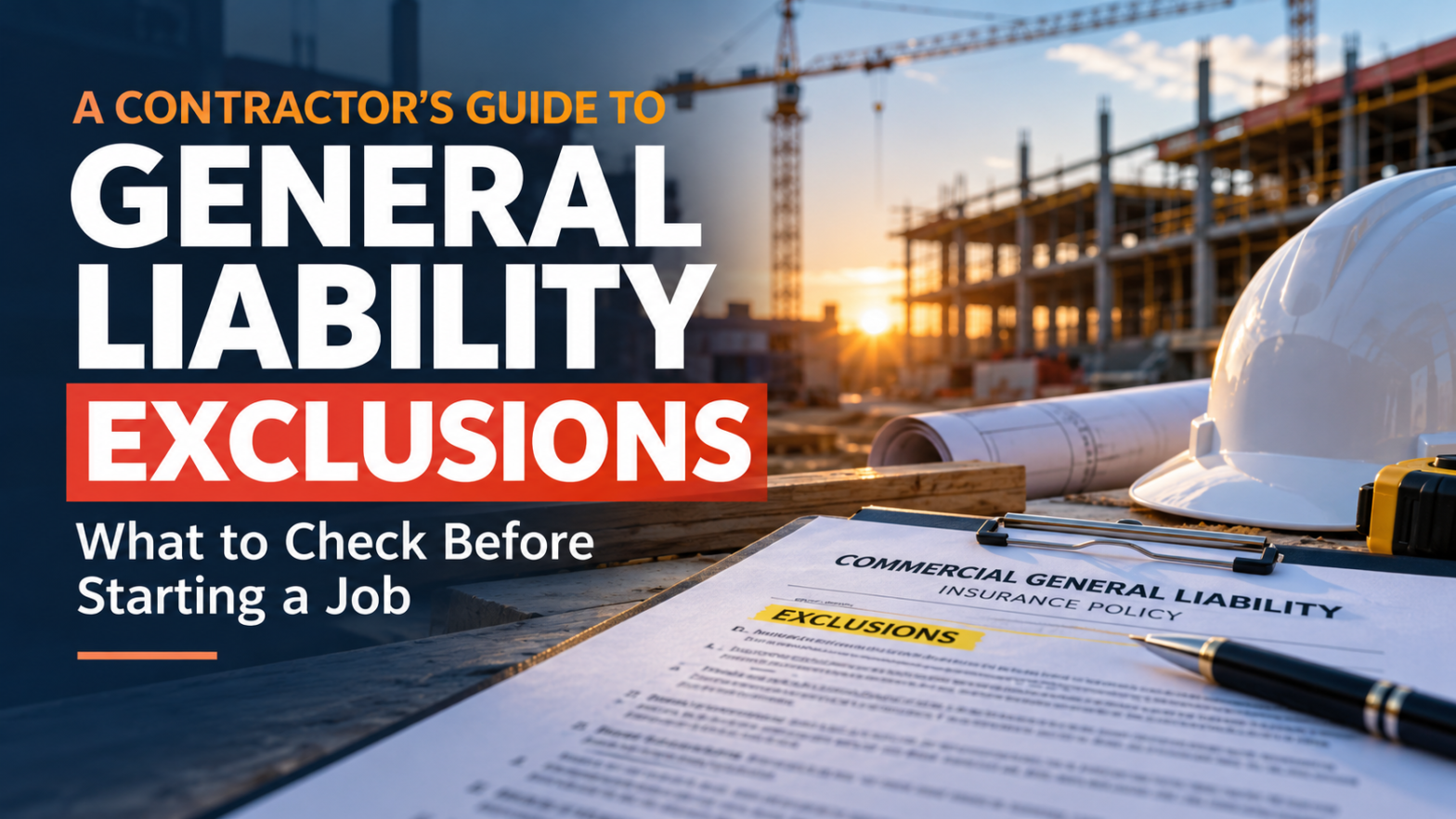
A contractor general liability exclusion is a policy provision that removes or limits coverage for specified risks, activities, circumstances, or types of claims. Exclusions can appear in the main coverage form or in endorsements that modify it. Understanding them helps you spot potential gaps before you bid, hire a subcontractor, or start work.
If you are comparing coverage for an upcoming project, start with our contractor general liability insurance overview and read the actual policy language—not just the certificate.
What Is an Exclusion on a Contractor General Liability Policy?
Commercial general liability (CGL) insurance generally addresses certain third-party bodily injury, property damage, and personal or advertising injury claims, subject to the terms of the policy. It is not a promise that every accident, construction defect, or business loss will be covered.
An exclusion identifies something the policy does not cover, or circumstances in which coverage is limited. Some exclusions are part of the standard coverage form. Others are introduced or changed by endorsements attached to the policy.
Where do you find the exclusions?
- Coverage form: The main contract describing coverage grants, definitions, exclusions, and conditions.
- Endorsement schedule: A list of forms attached to the policy that may change its terms.
- Individual endorsements: The actual wording that adds, removes, narrows, or clarifies coverage.
- Declarations: The summary of named insureds, limits, dates, and forms; useful, but not a substitute for reading the full policy.
Is an endorsement the same thing as an exclusion?
No. An exclusion is a restriction. An endorsement is a document that changes the policy. An endorsement may contain an exclusion, but it can also broaden coverage or add a required provision. That is why the endorsement’s exact wording matters.
Rich’s practical advice
A policy can look perfectly suitable on the declarations page. Then you read the attached conditions and exclusions and discover restrictions that change how it may respond. Ask your broker to walk through those forms with you.
Five Coverage Restrictions and Gaps Contractors Should Understand
These are common issues worth checking, not five identical exclusions found in every contractor policy. Some are specific exclusions; others are exposures that require different coverage or closer review.
1. Subcontracted work exclusions and conditions
General contractors often rely on subcontractors to complete portions of a project. Some CGL policies include restrictions tied to subcontracted operations. Others may require particular subcontractor insurance or written agreements as part of their terms.
Imagine a roofing subcontractor performs work that allegedly causes water damage. The property owner brings a claim against the general contractor. Whether the GC’s policy responds can depend on the allegations, the policy wording, and any subcontractor-related restrictions. The subcontractor’s own insurance and additional-insured arrangements may also matter.
This is one reason to review subcontractor insurance and risk management before a new sub starts work.
2. Damage to the work being performed
General liability is not a warranty on your workmanship. CGL policies contain property-damage exclusions that can affect damage to the particular work being performed, and other exclusions can apply to your work or product. The precise result depends on the policy wording, the timing of the loss, and any applicable exceptions.
Rich has described a window cleaner using a razor on specially coated glass at an ocean-view property. The razor scratched multiple panes. The example illustrates a difficult question: Is the claim for damage to the very work the contractor was performing, or for damage to other property?
That distinction can change the coverage analysis. Completed-operations provisions and subcontractor exceptions may also be relevant in other situations. Do not assume every workmanship-related claim is covered—or automatically excluded.
3. Pollution-related restrictions
Construction work can create exposures that do not look like a traditional accident. Picture a storm washing sediment and debris off a jobsite and onto neighboring property or a public roadway. Cleanup demands, property damage, and injury allegations may follow.
Many CGL policies contain pollution exclusions, although their wording and exceptions vary. Depending on the work and the contract, separate contractors pollution liability may be appropriate. The right question is not simply whether you have general liability, but whether your policies address the specific exposure the job creates.
4. Professional services restrictions
A contractor may do more than build from someone else’s plans. Some contractors provide design input, technical recommendations, or other professional services. Claims alleging mistakes in those services may fall outside a standard CGL policy or be affected by professional-services exclusions.
For example, if a contractor develops a design recommendation that allegedly leads to a defect, the exposure may differ from an accidental injury or property-damage claim arising from ordinary construction operations. Contractors professional liability may be worth reviewing when the work includes design or professional advice.
5. Vehicles, tools, and equipment
A general liability policy is not designed to address every loss involving work vehicles or business property. Auto-related exclusions can apply to certain vehicle accidents. Theft or damage involving your own tools and equipment generally raises different property-insurance questions.
Commercial auto coverage and inland marine or contractors equipment coverage can help address exposures that a CGL policy is not intended to handle, subject to their own terms. If you depend on trucks, rented equipment, or tools moving between jobsites, ask how those exposures are insured.
For a broader look at coverage gaps, see what your general liability policy may not cover.
Why Subcontractor Exclusions Deserve Special Attention
A GC may manage the whole job while subcontractors perform most of the hands-on work. That creates an important question: Who is responsible when a subcontractor’s work causes damage, and what insurance is available?
A subcontractor’s certificate is a starting point, not a complete risk-management process. You also need to understand the GC’s policy restrictions, the subcontractor’s actual policies, the written agreement, and any endorsements required by the job.
Rich’s three pillars of subcontractor risk management
- Verification: Collect and track general liability, workers’ compensation, commercial auto, and excess insurance when applicable. Watch renewal dates; each coverage line may expire on a different day.
- Documentation: Keep signed subcontractor agreements, current certificates, relevant endorsements, and organized subcontractor “T files” that can be located when needed.
- Risk transfer: Define the subcontractor’s responsibilities, required limits, indemnification obligations, and additional-insured requirements as appropriate to the contract and applicable law.
A W-9 is a tax document. It does not, by itself, establish that a worker is legally an independent subcontractor or that the GC has transferred liability. Read our guide to W-9s and subcontractor status for more context.
Does a Certificate of Insurance Show Policy Exclusions?
Usually not. A certificate of insurance (COI) summarizes reported policy information such as coverage types, limits, and effective dates. It generally does not list every exclusion, endorsement, or condition.
A certificate also does not amend a policy or create coverage that the policy does not provide. If a contract requires additional-insured status, primary and noncontributory wording, or a waiver of subrogation, the underlying policies and endorsements must be reviewed to determine what applies.
If your client has questioned a certificate, see our contractor certificate of insurance help page. The goal is not simply to produce a document; it is to make sure the insurance arrangements actually address the job requirements.
How to Check Exclusions Before Starting a Job
You do not need to memorize insurance forms. You do need to know which questions to ask—and have the right documents available when you ask them.
- Request the complete policy. Include the coverage form, declarations, schedule of forms, and every endorsement.
- Describe your actual operations. Tell your broker what you build, where you work, and which trades you subcontract.
- Look for operation-specific restrictions. Ask about subcontracted work, roofing, height or residential restrictions, professional services, pollution, and other terms relevant to your work.
- Compare the policy with the job requirements. Check requested limits, endorsements, additional-insured status, and completed-operations obligations.
- Resolve questions before the start date. Ask what the insurer will confirm or change and obtain the necessary documentation.
- Keep organized records. Save the policy, endorsements, contracts, certificates, and written responses with the job file.
What to ask your broker
“Can you show me the exclusions and endorsements that might affect this project or the subcontractors I plan to use?” A clear conversation now is better than discovering a restriction after a loss.
Why Exclusions Matter Before You Bid
Insurance requirements can be scattered throughout a construction contract. A project may require higher liability limits, specific endorsements, or specialized coverage that you do not currently carry. If you discover those obligations after the job is awarded, the added insurance expense can reduce the profit you expected to earn.
Some requirements may be negotiable; others may not. Rich often recommends reviewing them before bidding so the contractor can understand what the job requires and decide how to proceed.
Start with our construction job insurance requirements guide. If the contract calls for higher limits, our excess liability insurance for contractors page explains another coverage consideration.
What Should You Send Rich for a Policy Review?
A useful review starts with the actual documents and a quick explanation of the work. Send what you have, even if you are not sure which forms matter.
- Your current general liability policy, including the endorsements and forms schedule.
- The insurance requirements or relevant contract sections for the project.
- Any certificate request or special additional-insured wording.
- A short description of the work, the job location, and the subcontractors you expect to use.
- The bid deadline or anticipated job start date.
Rich can review the insurance documents with you, point out terms worth discussing, and help identify whether the existing coverage appears aligned with the project requirements. Any insurer decision or coverage change remains subject to the policy and carrier approval.
Have a policy or job requirement you’d like reviewed?
Send me your job requirements—I’ll review them with you. If you already have a general liability policy, send the complete policy and endorsements, too. We can look at the restrictions that may affect your work.
Prefer to talk? Call or text Rich: (916) 224-2270.
Frequently Asked Questions About Contractor General Liability Exclusions
Does every contractor general liability policy have the same exclusions?
No. General liability policies can differ by insurer, form, endorsements, operations, and underwriting terms. Review the full policy rather than assuming one contractor’s coverage is identical to another’s.
Does general liability cover work performed by subcontractors?
It may respond to some claims involving subcontracted work, but coverage depends on the policy, any subcontractor-related exclusions or conditions, and the facts of the claim. A general contractor should review its own coverage and the subcontractor’s insurance before work begins.
Can an endorsement remove coverage from a general liability policy?
Yes. Endorsements can restrict, remove, clarify, or expand coverage. They must be read alongside the main policy form.
Does a certificate of insurance show all policy exclusions?
No. A certificate generally summarizes reported insurance information. It does not list every exclusion, change policy terms, or create coverage.
Can a contractor request changes to an exclusion?
A contractor can ask a broker whether a restriction can be modified or whether another coverage option is available. Any change depends on the insurer’s terms and approval.
Should I review exclusions before bidding a construction project?
Yes. Reviewing policy restrictions alongside the project’s insurance requirements before bidding helps identify coverage questions and potential additional insurance obligations while there is still time to address them.
Know What Your Policy Says Before the Job Starts
Your certificate tells someone you have insurance. Your policy tells you what that insurance actually covers. The difference matters when you are managing subcontractors, accepting contract terms, or dealing with a claim.
If you are unsure about an exclusion, send your policy and the job requirements. We can read them together, identify the questions that matter, and discuss the next step.
— Rich Tygett, I.C. Insurance Solutions
Send me your job requirements—I’ll review them with you. Or call or text me anytime.