You have the subcontractor lined up. The schedule is set. Then the general contractor says: “We need their certificate of insurance before they can start.”
The subcontractor may have insurance, but the real question is whether it meets the project requirements.
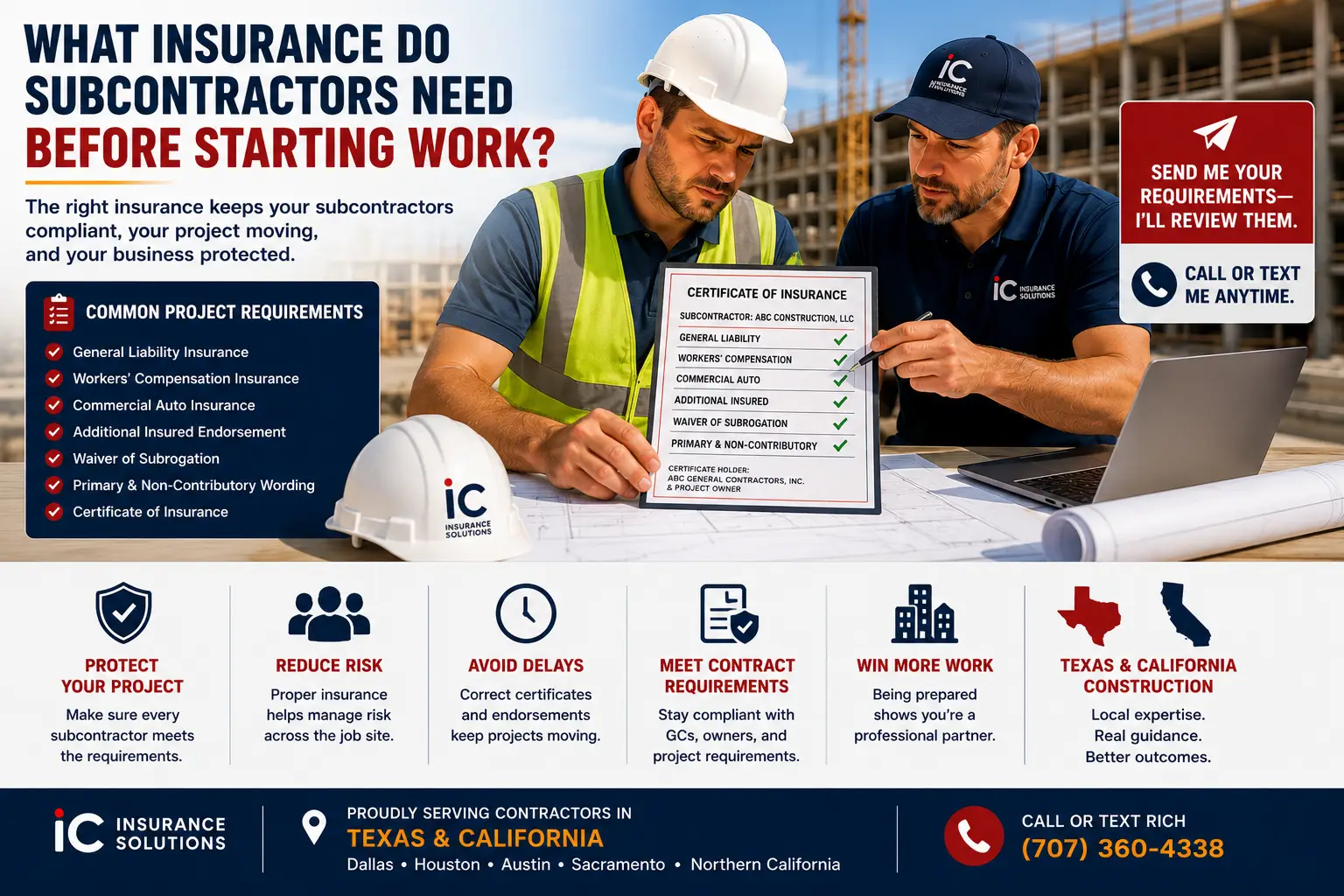
Before starting work, subcontractors commonly need general liability insurance, workers’ compensation when required, and commercial auto coverage when applicable. Some projects also require excess liability, additional insured endorsements, waiver of subrogation, and primary and non-contributory wording. The exact requirements depend on the agreement, operations, and applicable law.
A certificate of insurance is part of the process, but it does not guarantee that the underlying policy satisfies every requirement. This guide explains what general contractors should verify before subcontractors start work in Texas and California.
Send Me Your Requirements—I’ll Review Them Call or Text Rich
Key Takeaways
- Most commercial projects require subcontractors to provide insurance documentation before work begins.
- General liability is a common requirement; workers’ compensation, commercial auto, and excess liability may also be required.
- Additional insured, waiver of subrogation, and primary and non-contributory requirements should be checked against actual policy endorsements.
- A certificate summarizes reported insurance information; it does not create coverage.
- Review requirements early, organize subcontractor files, and track renewals.
Why General Contractors Require Subcontractor Insurance
General contractors coordinate the entire project. When a subcontractor arrives on site, the GC needs to know that the subcontractor’s coverage aligns with the agreement and the owner’s requirements.
Consider a framing subcontractor who provides a current general liability certificate. The agreement may also require workers’ compensation, additional insured coverage, and specific endorsements. A certificate alone may not establish that those requirements are met.
Missing coverage or paperwork can delay work, complicate audits, or leave important exposures unresolved. Paying someone as a 1099 or collecting a W-9 does not replace insurance verification. See our guide to W-9s and subcontractors.
General Liability Insurance
General liability is one of the most common subcontractor insurance requirements. Depending on the circumstances and policy terms, it may respond to certain third-party bodily injury, property damage, and completed operations claims.
For example, if a plumbing subcontractor accidentally damages other property during covered operations, general liability may respond. But exclusions and endorsements can restrict particular work or types of damage. A certificate showing limits does not confirm every exposure is covered.
Review the contractor general liability insurance page and confirm that the subcontractor’s operations and required limits are addressed.
Workers’ Compensation Insurance
Many construction projects require workers’ compensation documentation before employees begin work. Missing coverage can create injury and insurance-audit complications for both the subcontractor and general contractor.
Texas does not generally require most private employers to subscribe to workers’ compensation, but contracts and certain projects may impose requirements. California generally requires employers to provide workers’ compensation for employees, and contractor licensing rules can create additional obligations.
Verify the subcontractor’s circumstances and applicable requirements rather than assuming that a small business or sole proprietor is exempt. See workers’ compensation insurance.
Commercial Auto Insurance
When subcontractors use work trucks, vans, hired vehicles, or non-owned vehicles for the project, commercial auto coverage may be required by the agreement.
Check vehicle-related requirements and limits; general liability generally does not substitute for automobile liability coverage. See commercial auto insurance and our guide to subcontractor certificates of insurance.
Excess Liability Insurance
Larger projects sometimes require liability limits above those provided by underlying policies. Excess liability may provide additional limits over specified underlying coverage, subject to its own terms and exclusions.
Confirm which underlying policies the excess coverage follows and whether the combined limits satisfy the job requirements. See excess liability insurance for contractors.
Additional Insured Requirements
Subcontract agreements often require the GC and sometimes the owner to be included as additional insureds. This is different from merely listing someone as a certificate holder.
Check whether the required endorsement applies to ongoing operations, completed operations, or both, as specified by the agreement. See additional insured coverage for contractors.
Waiver of Subrogation Requirements
A waiver of subrogation can affect an insurer’s ability to seek recovery from another party after paying a covered claim. Whether it applies depends on the coverage line and policy or endorsement language.
Identify this requirement before submitting paperwork. See waiver of subrogation for contractors.
Primary and Non-Contributory Requirements
Primary and non-contributory provisions often appear with additional insured requirements. Broadly, they address the order in which applicable insurance responds and whether the additional insured’s own coverage contributes.
Confirm the applicable wording rather than assuming it follows automatically from additional insured status. See primary and non-contributory requirements.
Certificate of Insurance Requirements
A certificate of insurance summarizes reported policy information, such as insured name, coverage types, limits, and dates. A certificate does not amend, extend, or create insurance coverage. The actual policies and endorsements control.
Check the named insured, limits, effective dates, certificate holder, and any required endorsements. For a practical review, visit contractor certificate of insurance help.
Common Insurance Mistakes Subcontractors Make
- Waiting until the last minute to request a certificate.
- Assuming last job’s requirements apply.
- Overlooking additional insured endorsements.
- Carrying insufficient limits.
- Using expired documents.
- Ignoring contractual wording.
- Overlooking policy exclusions.
- And failing to track renewals.
Related: why contractors get rejected over insurance requirements.
The Three Pillars of Subcontractor Risk Management
1. Verification: Confirm general liability, workers’ compensation, commercial auto, and excess coverage where applicable, together with limits, endorsements, and expiration dates. Policies may renew on different dates.
2. Documentation: Keep a dedicated subcontractor “T file” with the signed agreement, certificates, endorsements, renewal information, and correspondence. Organized records help during project reviews and insurance audits.
3. Risk Transfer: Use a written subcontractor agreement to clarify operations, responsibility, indemnification, additional insured status, and required limits. A W-9 alone does not establish proper risk transfer.
For a deeper explanation, see subcontractor insurance and risk management for general contractors.
Texas vs. California Subcontractor Requirements
Texas: Requirements vary by owner, GC, and project. Larger commercial, industrial, and municipal projects may require more extensive documentation. Workers’ compensation is not universally mandatory for most private employers, but contractual and specific legal obligations may apply.
California: Construction projects may involve detailed documentation, especially on public works and larger commercial projects. Workers’ compensation obligations are generally stricter, with additional contractor licensing considerations.
On either side of the state line, review the actual agreement and applicable law. See construction job insurance requirements.
For the project-specific requirements that matter before a bid or mobilization, review the contract alongside the coverage documents.
Subcontractor Insurance Checklist Before Starting Work
- Review the signed subcontract agreement and project requirements.
- Verify general liability coverage, limits, and relevant operations.
- Confirm workers’ compensation requirements under applicable law and contract.
- Check commercial auto requirements for work-related vehicles.
- Confirm excess liability limits where required.
- Verify additional insured endorsements and their scope.
- Check waiver of subrogation requirements.
- Check primary and non-contributory wording.
- Review the insured name, certificate holder, dates, and limits.
- Identify exclusions that may affect the subcontractor’s operations.
- Keep signed agreements, certificates, and endorsements in a T file.
- Track renewals and resolve questions before mobilization.
Before Your Subcontractor Starts Work
Send me the subcontract agreement, insurance requirements, certificates, and endorsements you have. I’ll review them with you and help identify what the job is asking for and which questions need to be resolved before work begins.
Send me your job requirements—I’ll review them with you. Call or text me anytime.
Frequently Asked Questions
What insurance do subcontractors need?
Subcontractors commonly need general liability, and projects may also require workers’ compensation, commercial auto, or excess liability. Endorsements and other requirements depend on the contract, operations, and applicable laws.
Do subcontractors need general liability insurance?
It is one of the most common contractual requirements for construction subcontractors. Legal and contractual requirements depend on the circumstances.
Do subcontractors need workers’ compensation?
Often, yes. Requirements depend on state law, employment arrangements, licensing rules where relevant, and the project agreement.
Can a subcontractor start work without a certificate?
Many commercial projects require acceptable insurance documentation before work begins. Check the subcontract and project requirements.
Is a certificate of insurance enough to verify coverage?
Not always. A certificate summarizes reported insurance information but does not create or change coverage. Policies and endorsements may need review.
Are requirements different in Texas and California?
Yes. The states have different workers’ compensation and contractor rules, and each project can impose additional contractual requirements.